Match the specific phase of meiosis with the correct description. ________Prophase I ________Metaphase I ________Anaphase I ________ Telophase I ________Prophase II ________Metaphase II ________Anaphase II ________ Telophase II a. Homologous chromosomes arrive at opposite poles. b. Homologous chromosomes line up. c. Chromosomes line up at the equator. d. Independent assortment occurs. e. Separated sister chromatids arrive at opposite poles. f. Sister chromatids remain condensed. g. Crossing over occurs. h. Sister chromatids pull apart.
Verified step by step guidance
1
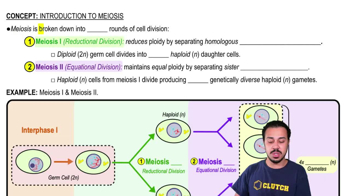
Understand that meiosis is a two-part process (Meiosis I and Meiosis II) that reduces the chromosome number by half and is essential for sexual reproduction. Each phase has specific events that occur.
Match the descriptions to the phases of Meiosis I:
- Prophase I: Crossing over occurs (g). This is when homologous chromosomes exchange genetic material, increasing genetic diversity.
- Metaphase I: Homologous chromosomes line up (b). This is when homologous pairs align at the metaphase plate.
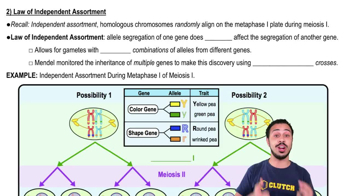
- Anaphase I: Independent assortment occurs (d). Homologous chromosomes are pulled to opposite poles, ensuring genetic variation.
- Telophase I: Homologous chromosomes arrive at opposite poles (a). The cell begins to divide into two haploid cells.
Match the descriptions to the phases of Meiosis II:
- Prophase II: Sister chromatids remain condensed (f). This phase prepares the chromosomes for the second division.
- Metaphase II: Chromosomes line up at the equator (c). This is similar to metaphase in mitosis, but involves haploid cells.
- Anaphase II: Sister chromatids pull apart (h). The chromatids are separated and move to opposite poles.
- Telophase II: Separated sister chromatids arrive at opposite poles (e). This results in four haploid daughter cells.
Review the key differences between Meiosis I and Meiosis II: Meiosis I separates homologous chromosomes, while Meiosis II separates sister chromatids. This distinction helps in correctly matching the descriptions.
Double-check your matches by ensuring that each description corresponds to the correct phase based on the events that occur during meiosis. This will help reinforce your understanding of the process.
Verified video answer for a similar problem:
This video solution was recommended by our tutors as helpful for the problem above
Play a video:
Was this helpful?
Key Concepts
Here are the essential concepts you must grasp in order to answer the question correctly.
Meiosis Stages
Meiosis consists of two sequential divisions: meiosis I and meiosis II, each with distinct phases. In meiosis I, homologous chromosomes are separated, while meiosis II separates sister chromatids. Understanding these stages is crucial for matching the phases with their descriptions.
Homologous chromosomes are pairs of chromosomes, one inherited from each parent, that are similar in shape, size, and genetic content. During meiosis I, these chromosomes undergo processes like crossing over and independent assortment, which are essential for genetic diversity.
The behavior of chromosomes during meiosis includes processes such as alignment at the metaphase plate, separation during anaphase, and the formation of new nuclei in telophase. Recognizing how chromosomes behave in each phase helps in accurately matching the phases with their corresponding descriptions.