
Mark the following statements as true or false. If a statement is false, correct it to make a true statement. The Na+/K+ pumps and gated channels maintain the Na+ and K+ gradients necessary for action potentials to occur.
Verified step by step guidance
1
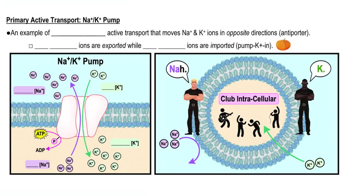
Understand the role of the Na+/K+ pump: The Na+/K+ pump is a membrane protein that actively transports sodium (Na⁺) out of the cell and potassium (K⁺) into the cell against their concentration gradients using ATP. This establishes and maintains the resting membrane potential, which is essential for action potentials.
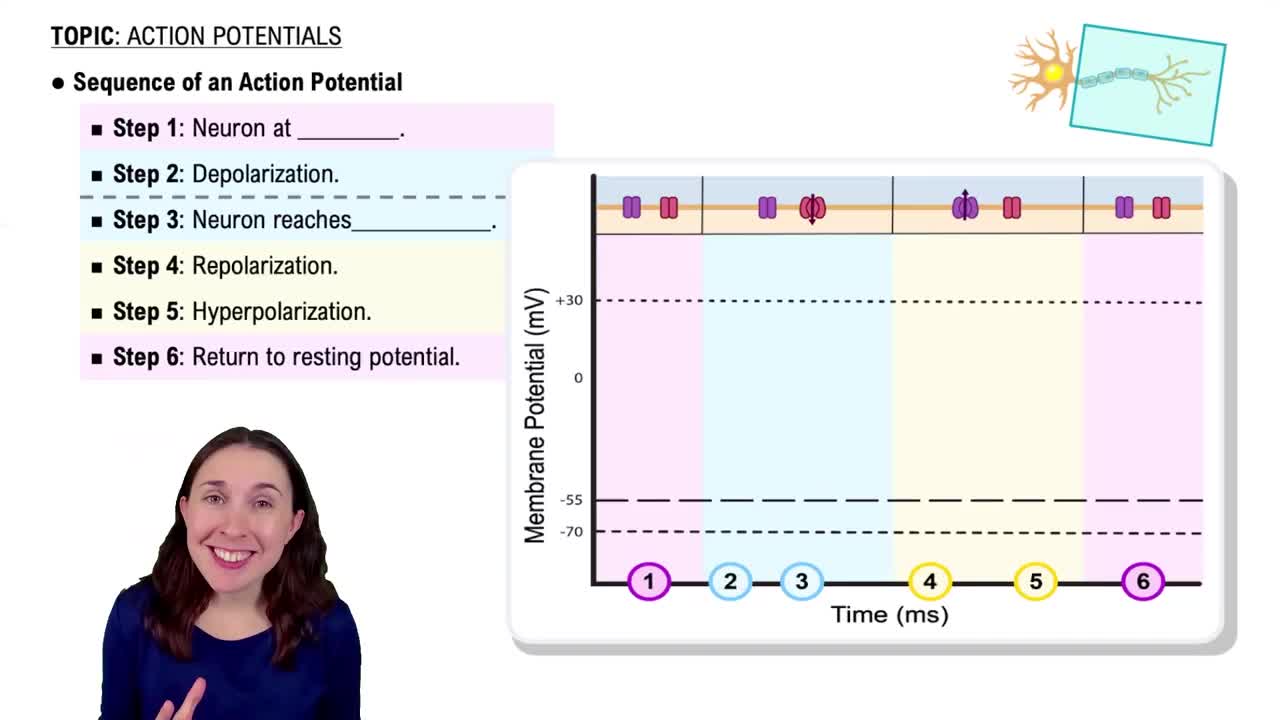
Understand the role of gated channels: Gated channels (e.g., voltage-gated Na⁺ and K⁺ channels) are responsible for the rapid changes in ion permeability during an action potential. They open and close in response to specific stimuli, allowing ions to flow down their concentration gradients.
Evaluate the statement: The statement claims that both the Na⁺/K⁺ pumps and gated channels maintain the Na⁺ and K⁺ gradients necessary for action potentials. While the Na⁺/K⁺ pump maintains the ion gradients, gated channels do not maintain these gradients but instead facilitate ion movement during the action potential.
Correct the false part of the statement: The corrected statement should read: 'The Na⁺/K⁺ pumps maintain the Na⁺ and K⁺ gradients necessary for action potentials to occur, while gated channels facilitate the movement of these ions during the action potential.'
Summarize the key takeaway: The Na⁺/K⁺ pump is responsible for maintaining the resting ion gradients, and gated channels are involved in the dynamic changes during the action potential itself.
Was this helpful?
Key Concepts
Here are the essential concepts you must grasp in order to answer the question correctly.
Na+/K+ Pump
The Na+/K+ pump is a vital membrane protein that actively transports sodium (Na+) out of the cell and potassium (K+) into the cell, using ATP for energy. This process is essential for maintaining the electrochemical gradients of these ions across the cell membrane, which are crucial for various cellular functions, including the generation of action potentials in neurons.
An action potential is a rapid, temporary change in the membrane potential of a neuron, allowing it to transmit signals. It occurs when a threshold level of depolarization is reached, leading to the opening of voltage-gated sodium channels, followed by the opening of potassium channels to repolarize the membrane. The Na+/K+ pump helps restore the resting membrane potential after an action potential.
Gated channels are specialized protein structures in the cell membrane that open or close in response to specific stimuli, such as changes in voltage or the binding of a molecule. In the context of action potentials, voltage-gated sodium and potassium channels play a critical role in the rapid depolarization and repolarization phases, respectively, allowing for the propagation of electrical signals along neurons.