Describe the erectile tissues of the penis. How does erection occur?
Verified step by step guidance
1
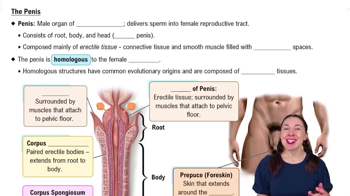
Identify the three main erectile tissues of the penis: two corpora cavernosa and one corpus spongiosum. The corpora cavernosa are paired cylindrical structures located dorsally, while the corpus spongiosum surrounds the urethra ventrally.
Explain the structure of these tissues, emphasizing that they consist of spongy vascular spaces (sinusoids) lined with endothelium and surrounded by smooth muscle and connective tissue, which allow them to fill with blood.
Describe the physiological process of erection, starting with sexual arousal that triggers parasympathetic nerve signals leading to the release of nitric oxide (NO) in the penile arteries.
Explain how nitric oxide causes relaxation of the smooth muscle in the walls of the arteries and the trabeculae within the erectile tissues, resulting in vasodilation and increased blood flow into the sinusoids of the corpora cavernosa and corpus spongiosum.
Detail how the increased blood volume expands the erectile tissues, compressing the veins that normally drain blood from the penis, thus trapping blood within the tissues and maintaining the erection until sympathetic signals cause muscle contraction and blood outflow resumes.
Verified video answer for a similar problem:
This video solution was recommended by our tutors as helpful for the problem above
Play a video:
Was this helpful?
Key Concepts
Here are the essential concepts you must grasp in order to answer the question correctly.
Erectile Tissues of the Penis
The penis contains three main erectile tissues: two corpora cavernosa and one corpus spongiosum. The corpora cavernosa are paired cylindrical structures that fill with blood during erection, while the corpus spongiosum surrounds the urethra and prevents it from being compressed. These tissues are composed of spongy vascular spaces lined with endothelium.
Erection occurs when the smooth muscles in the erectile tissues relax, allowing blood to fill the vascular spaces. This process is triggered by neural signals that cause vasodilation of penile arteries and restrict venous outflow, leading to increased pressure and rigidity. Parasympathetic stimulation plays a key role in initiating this response.
Erection is controlled by a complex interaction between the nervous system and blood vessels. Parasympathetic nerves release nitric oxide, which induces smooth muscle relaxation and vasodilation. The increased arterial inflow and restricted venous drainage result in engorgement of erectile tissues, producing an erection.