Ch. 15 The Special Senses
Amerman - Human Anatomy & Physiology 2nd Edition
Amerman2nd EditionHuman Anatomy & PhysiologyISBN: 9780136873822Not the one you use?Change textbook
Chapter 15, Problem L2.4

Following a stroke, a patient lost vision in the left visual field. Name several structures in the brain that could have been damaged by the stroke to have caused this vision loss. Be specific as to right or left side.

Verified step by step guidance
1
Understand that the visual field is processed contralaterally in the brain, meaning the left visual field is processed by structures on the right side of the brain.
Identify the primary structures involved in visual processing, such as the optic nerve, optic chiasm, optic tract, lateral geniculate nucleus (LGN) of the thalamus, and the primary visual cortex (occipital lobe). Damage to these structures can disrupt vision.
Recognize that damage to the right optic tract could result in loss of vision in the left visual field because the optic tract carries information from the contralateral visual field.
Consider the possibility of damage to the right lateral geniculate nucleus (LGN) in the thalamus, which relays visual information to the primary visual cortex. Damage here could also cause left visual field loss.
Evaluate the likelihood of damage to the right primary visual cortex (occipital lobe), specifically the region responsible for processing the left visual field. This is a common site of injury following a stroke that results in visual field deficits.

Verified video answer for a similar problem:

This video solution was recommended by our tutors as helpful for the problem above.
Was this helpful?

Key Concepts

Here are the essential concepts you must grasp in order to answer the question correctly.

Visual Field Processing

The visual field is divided into left and right halves, with each half processed by the opposite hemisphere of the brain. Damage to the right hemisphere can lead to loss of vision in the left visual field, a condition known as homonymous hemianopia. Understanding this lateralization is crucial for identifying which brain structures may be affected by a stroke.
Recommended video:
04:19
1) RNA Processing

Occipital Lobe

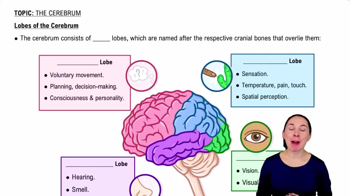
The occipital lobe, located at the back of the brain, is primarily responsible for visual processing. It contains the primary visual cortex (V1), which interprets visual information from the eyes. A stroke affecting the right occipital lobe can disrupt the processing of visual stimuli from the left visual field, leading to vision loss.
Recommended video:
2:50
Lobes of the Cerebrum

Optic Radiations

Optic radiations are neural pathways that transmit visual information from the lateral geniculate nucleus of the thalamus to the visual cortex in the occipital lobe. Damage to the right optic radiations can result in loss of vision in the left visual field. Identifying these pathways is essential for understanding how strokes can impact visual perception.
Recommended video:
Guided course
5:04
Optic Components