
Textbook Question
The point of the elbow is actually the _____ of the ulna.
(a) Styloid process
(b) Olecranon
(c) Coronoid process
(d) Trochlear notch
961
views
1
rank

 Verified step by step guidance
 02:40
02:40
 03:59
03:59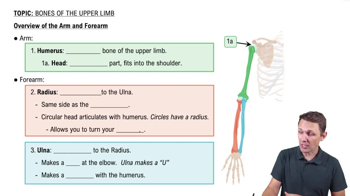 5:30
5:30The point of the elbow is actually the _____ of the ulna.
(a) Styloid process
(b) Olecranon
(c) Coronoid process
(d) Trochlear notch
Which of the following is primarily responsible for stabilizing, positioning, and bracing the pectoral girdle?
(a) Tendons
(b) Ligaments
(c) The joint shape
(d) Muscles
(e) The shape of the bones within the joint
In the following photographs of the scapula, identify the three views (a–c) and the indicated bone markings (d–g).
-+
a. ___
b. ___
c. ___
d. ___
e. ___
f. ___
g.___
The epiphysis of the femur articulates with the pelvis at the (a) pubic symphysis, (b) acetabulum, (c) sciatic notch, (d) obturator foramen.
The bones of the hand articulate distally with the:
(a) Carpal bones
(b) Ulna and radius
(c) Metacarpals
(d) Phalanges