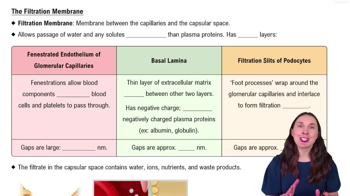
Understand that the glomerulus is a network of capillaries located within the nephron of the kidney, and its primary role is filtration.
Learn that the glomerulus filters blood by allowing water, ions, and small molecules to pass through its walls while retaining larger molecules like proteins and blood cells.
Recognize that the filtration process occurs due to the high blood pressure within the glomerular capillaries, which forces substances through the filtration membrane.
Explore the structure of the filtration membrane, which consists of three layers: the endothelium of the capillaries, the basement membrane, and the podocytes of the Bowman's capsule.
Understand that the filtrate produced by the glomerulus enters the Bowman's capsule and proceeds through the nephron for further processing into urine.
Verified video answer for a similar problem:
This video solution was recommended by our tutors as helpful for the problem above
Video duration:
2m
Play a video:
0 Comments
Key Concepts
Here are the essential concepts you must grasp in order to answer the question correctly.
Glomerulus Structure
The glomerulus is a network of tiny blood vessels (capillaries) located in the kidney's nephron. It is surrounded by Bowman's capsule and plays a crucial role in filtering blood. The structure allows for the efficient exchange of substances between the blood and the filtrate, which is essential for kidney function.
The primary function of the glomerulus is to filter blood, a process known as glomerular filtration. During this process, blood pressure forces water, ions, and small molecules through the capillary walls into Bowman's capsule, forming a filtrate. This initial filtration is critical for the subsequent reabsorption and secretion processes that occur in the nephron.
The glomerulus plays a vital role in maintaining homeostasis by regulating the composition of blood and the volume of bodily fluids. By filtering out waste products and excess substances, it helps to balance electrolytes, maintain blood pressure, and ensure the proper functioning of the body's systems. This regulation is essential for overall health and well-being.