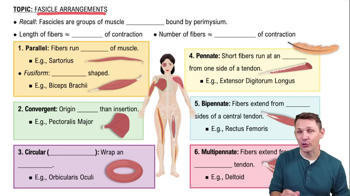
List the four patterns of fascicle arrangement used to classify the different types of skeletal muscles.
Verified step by step guidance
1
Understand that fascicle arrangement refers to the way muscle fibers (fascicles) are organized within a skeletal muscle, which affects the muscle's range of motion and power.
Identify the first pattern: Parallel fascicles, where fibers run parallel to the long axis of the muscle, allowing for greater range of motion.
Identify the second pattern: Fusiform fascicles, which are spindle-shaped with a thick middle and tapered ends, combining power and range of motion.
Identify the third pattern: Pennate fascicles, where fibers are short and attach obliquely to a central tendon; this pattern is subdivided into unipennate, bipennate, and multipennate based on fiber arrangement.
Identify the fourth pattern: Circular fascicles, where fibers are arranged in concentric rings, typically forming sphincter muscles that control openings.
Verified video answer for a similar problem:
This video solution was recommended by our tutors as helpful for the problem above
Video duration:
2m
Play a video:
Was this helpful?
Key Concepts
Here are the essential concepts you must grasp in order to answer the question correctly.
Fascicle Arrangement
Fascicle arrangement refers to the pattern in which muscle fibers (fascicles) are organized within a skeletal muscle. This arrangement influences the muscle's strength, range of motion, and function. Understanding these patterns helps classify muscles based on their structural and functional characteristics.
In the parallel pattern, fascicles run parallel to the muscle's long axis. This arrangement allows for greater range of motion but less force production. Examples include muscles like the sartorius and biceps brachii.
Pennate muscles have fascicles that attach obliquely to a central tendon, increasing force production. They are classified into unipennate, bipennate, and multipennate based on the number of tendon sides the fascicles attach to. Examples include the extensor digitorum (unipennate) and deltoid (multipennate).