
Textbook Question
Mark the following statements about bone tissue as true or false. If a statement is false, correct it to make a true statement.
b. The inorganic matrix of bone is solely responsible for the strength of bone tissue.
687
views
 Verified step by step guidance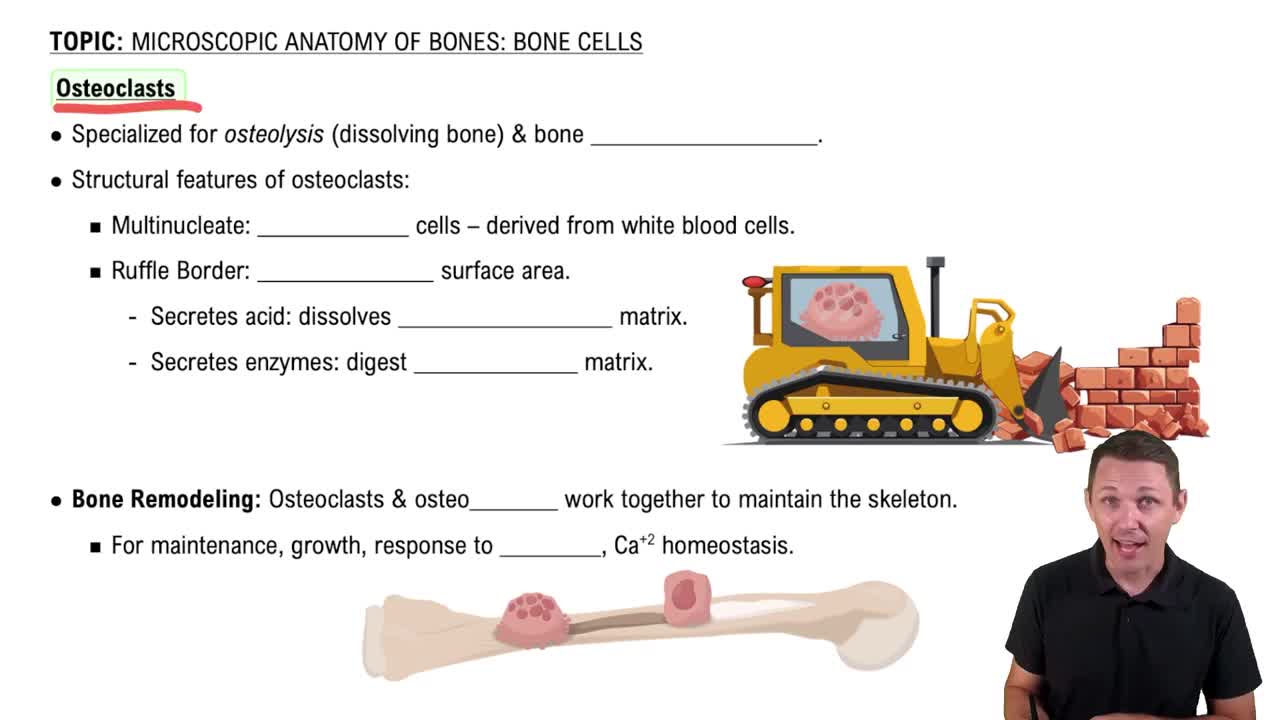
 4:34
4:34 4:34
4:34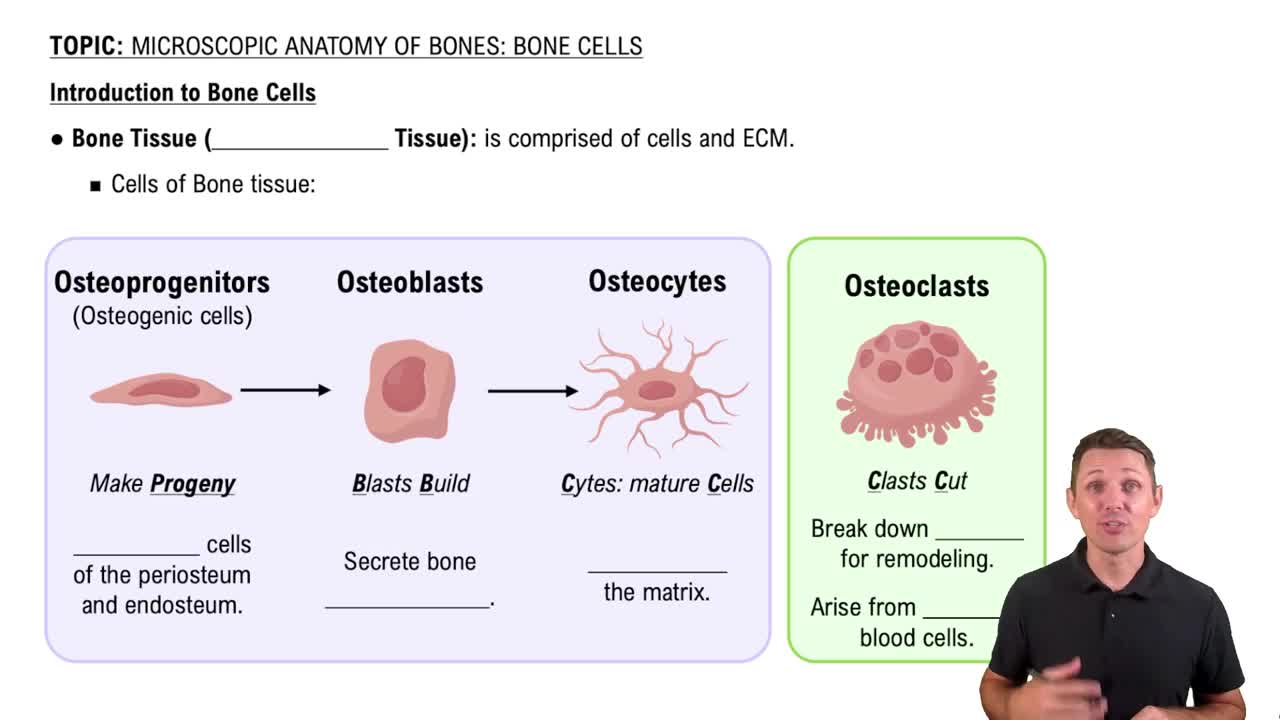 4:19
4:19Mark the following statements about bone tissue as true or false. If a statement is false, correct it to make a true statement.
b. The inorganic matrix of bone is solely responsible for the strength of bone tissue.
Mark the following statements about bone tissue as true or false. If a statement is false, correct it to make a true statement.
c. Collagen fibers are one of the predominant parts of the inorganic matrix.
Mark the following statements about bone tissue as true or false. If a statement is false, correct it to make a true statement.
d. The collagen fibers of bone help it to resist torsion and tension.
The subunit of compact bone is the _____ . It consists of rings of bone matrix called ______that surround a structure called the______ that contains blood vessels and nerves. Other structures called _______also contain blood vessels and nerves. Osteocytes are housed in_____and communicate via_______.
The branching pieces of bone in spongy bone are called:
a. Lamellae
b. Lacunae
c. Osteoclasts
d. Trabeculae
Mark the following statements about bone tissue as true or false. If a statement is false, correct it to make a true statement.
f. Osteocytes are mature and less active osteoblasts that have become surrounded by bone ECM.