
The action of the biceps brachii muscle on the hinge joint of the elbow is an example of which kind of lever system? a. First class b. Second class c. Third class d. Fourth class
Verified step by step guidance
1
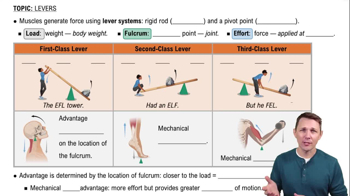
Understand the three types of lever systems in the human body: First-class levers have the fulcrum between the effort and the load, second-class levers have the load between the effort and the fulcrum, and third-class levers have the effort between the load and the fulcrum.
Identify the components of the lever system in the action of the biceps brachii muscle at the elbow joint: The fulcrum is the hinge joint of the elbow, the load is the weight being lifted (e.g., the forearm or an object in the hand), and the effort is the contraction of the biceps brachii muscle.
Determine the position of the effort relative to the fulcrum and the load: In this case, the effort (biceps brachii contraction) is applied between the fulcrum (elbow joint) and the load (forearm or object being lifted).
Compare this arrangement to the definitions of the lever systems: Since the effort is between the fulcrum and the load, this matches the characteristics of a third-class lever system.
Conclude that the action of the biceps brachii muscle on the hinge joint of the elbow is an example of a third-class lever system.
Verified video answer for a similar problem:
This video solution was recommended by our tutors as helpful for the problem above
Play a video:
Was this helpful?
Key Concepts
Here are the essential concepts you must grasp in order to answer the question correctly.
Lever Systems
A lever system consists of a rigid bar (the lever) that pivots around a fixed point called the fulcrum. In biomechanics, levers are classified into three types based on the relative positions of the effort, load, and fulcrum. Understanding these classifications helps in analyzing how muscles and joints work together to produce movement.
There are three classes of levers: first class, second class, and third class. In a first-class lever, the fulcrum is between the effort and the load (e.g., a seesaw). In a second-class lever, the load is between the fulcrum and the effort (e.g., a wheelbarrow). In a third-class lever, the effort is applied between the fulcrum and the load (e.g., the biceps brachii at the elbow).
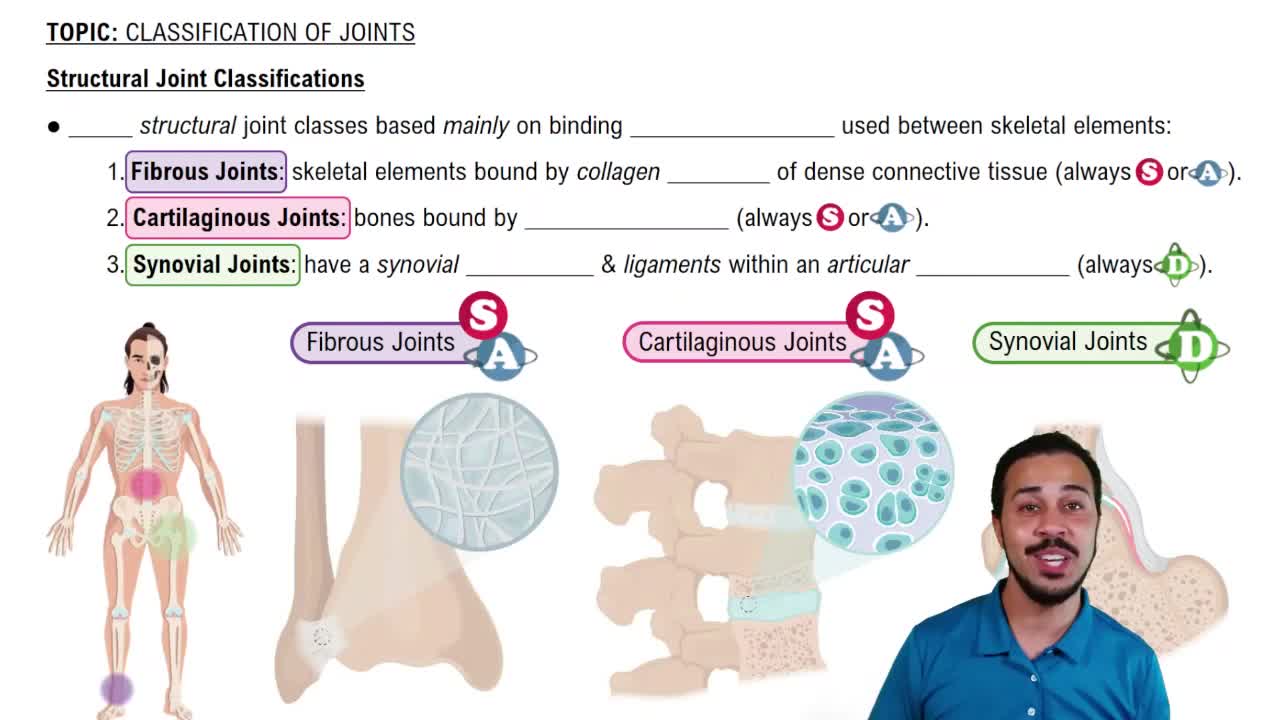
The biceps brachii muscle acts on the elbow joint, which is a hinge joint allowing flexion and extension. When the biceps contracts, it applies force to the forearm, lifting the load (e.g., weight in the hand). This action exemplifies a third-class lever system, where the effort (muscle contraction) is applied between the fulcrum (elbow joint) and the load (weight in hand).