
Textbook Question
Relate the structure of hemoglobin to its function.
1199
views

 Verified step by step guidance
 01:07
01:07
 6:11
6:11 05:07
05:07Relate the structure of hemoglobin to its function.
A difference between the A, B, and O blood types and the Rh factor is:
(a) Rh agglutinogens are not found on the surface of red blood cells
(b) Rh agglutinogens do not produce a cross-reaction
(c) Individuals who are Rh− do not carry agglutinins to Rh factor unless they have been previously sensitized
(d) Rh agglutinogens are found free in the plasma
(e) Rh agglutinogens are found bound to plasma proteins
How do red blood cells differ from white blood cells in both form and function?
Why is aspirin sometimes prescribed for the prevention of vascular problems?
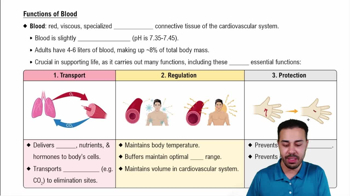
How do elements of blood defend against toxins and pathogens in the body?
A test for prothrombin time is used to identify deficiencies in the extrinsic clotting pathway; prothrombin time is prolonged if any of the factors are deficient. A test for activated partial thromboplastin time is used in a similar fashion to detect deficiencies in the intrinsic clotting pathway. Which factor would be deficient if a person had a prolonged prothrombin time but a normal partial thromboplastin time?