Ch. 22 The Lymphatic System and Immunity
Martini - Fundamentals of Anatomy & Physiology 11th Edition
Martini, Nath, Bartholomew11th EditionFundamentals of Anatomy & PhysiologyISBN: 9780136874089Not the one you use?Change textbook
Chapter 22, Problem 5

The major histocompatibility complex (MHC)
(a) Is responsible for forming lymphocytes
(b) Produces antibodies in lymph glands
(c) Is a group of genes that codes for human leukocyte antigens
(d) Is a membrane protein that can recognize foreign antigens
(e) Is the antigen found on bacteria that stimulates an immune response

Verified step by step guidance
1
Step 1: Understand the role of the major histocompatibility complex (MHC) in the immune system. MHC is a set of genes that plays a crucial role in immune response by helping the body recognize foreign molecules.
Step 2: Review each option carefully and relate it to the known functions of MHC. For example, forming lymphocytes (a) and producing antibodies (b) are functions related to immune cells but not directly linked to MHC genes.
Step 3: Recall that MHC genes code for proteins called human leukocyte antigens (HLAs), which are found on the surface of cells and help the immune system distinguish self from non-self.
Step 4: Differentiate between MHC molecules and antigens. MHC molecules present antigens but are not themselves antigens found on bacteria (e). Also, MHC is not a single membrane protein but a group of proteins coded by a gene complex.
Step 5: Conclude that the correct understanding is that MHC is a group of genes coding for human leukocyte antigens, which are essential for immune recognition.

Verified video answer for a similar problem:

This video solution was recommended by our tutors as helpful for the problem above.
Was this helpful?

Key Concepts

Here are the essential concepts you must grasp in order to answer the question correctly.

Major Histocompatibility Complex (MHC)

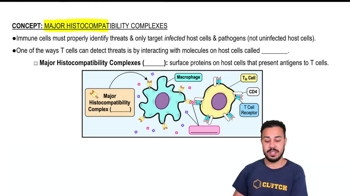
MHC is a set of genes that encode proteins found on cell surfaces, which help the immune system recognize foreign molecules. These proteins present antigen fragments to T cells, triggering an immune response. MHC is crucial for distinguishing self from non-self in the body.
Recommended video:
2:31
Major Histocompatibility Complexes

Human Leukocyte Antigens (HLA)

HLA are the specific proteins encoded by the MHC genes in humans. They are found on the surface of most cells and play a key role in immune system regulation by presenting peptides to immune cells. HLA diversity affects tissue compatibility in transplants.
Recommended video:
2:33
Leukocytes Example 1

Antigen Recognition and Immune Response

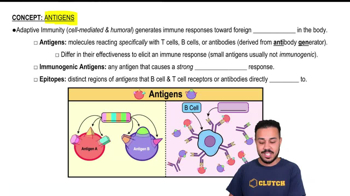
Antigens are molecules that the immune system identifies as foreign, often parts of pathogens like bacteria or viruses. MHC molecules present these antigens to lymphocytes, enabling the immune system to detect and respond to infections effectively.
Recommended video:
3:59
Antigens