a. What is the function of the basal nuclei? b. Which basal nuclei form the striatum? c. Which arches over the diencephalon?
Verified step by step guidance
1
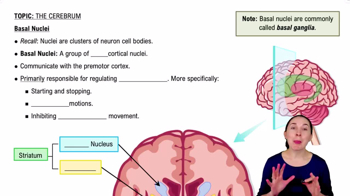
For part (a), understand that the basal nuclei (also called basal ganglia) are a group of subcortical nuclei in the brain involved primarily in regulating voluntary motor movements, procedural learning, and routine behaviors or habits. Their function includes modulating movement initiation and coordination.
For part (b), identify the specific basal nuclei that together form the striatum. The striatum is composed of the caudate nucleus and the putamen. Recognize that these two structures are functionally and anatomically linked as the input center of the basal nuclei.
For part (c), determine which brain structure arches over the diencephalon. The answer is the corpus callosum, a large bundle of nerve fibers that connects the two cerebral hemispheres and arches over the diencephalon, facilitating interhemispheric communication.
Summarize the answers by clearly linking each part of the question to the relevant anatomical structures and their functions: (a) basal nuclei function in motor control, (b) striatum consists of caudate nucleus and putamen, and (c) corpus callosum arches over the diencephalon.
Review the anatomical locations and relationships of these structures in the brain to reinforce understanding, using diagrams or brain models if available.
Verified video answer for a similar problem:
This video solution was recommended by our tutors as helpful for the problem above
Video duration:
3m
Play a video:
Was this helpful?
Key Concepts
Here are the essential concepts you must grasp in order to answer the question correctly.
Function of the Basal Nuclei
The basal nuclei are groups of neurons in the brain that regulate voluntary motor control, procedural learning, and routine behaviors. They help coordinate movement by modulating signals from the cerebral cortex to ensure smooth and purposeful actions. Dysfunction in these nuclei can lead to movement disorders like Parkinson's disease.
The striatum is a major component of the basal nuclei, primarily formed by the caudate nucleus and the putamen. These structures receive input from the cerebral cortex and are involved in motor and cognitive functions, acting as the main input center for the basal nuclei circuitry.
The structure that arches over the diencephalon is the corpus callosum, a thick band of nerve fibers connecting the two cerebral hemispheres. It facilitates communication between the hemispheres, integrating sensory, motor, and cognitive information across the brain.