Mark the following statements as true or false. If a statement is false, correct it to make a true statement. A sudden increase or decrease in blood pressure triggers the baroreceptor reflex, which is mediated by the medulla and the autonomic nervous system.
Verified step by step guidance
1
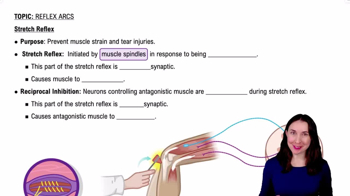
Step 1: Understand the baroreceptor reflex. The baroreceptor reflex is a mechanism that helps regulate blood pressure by detecting changes in the stretch of blood vessel walls, primarily in the carotid arteries and aortic arch. These stretch receptors send signals to the medulla oblongata in the brainstem.
Step 2: Analyze the role of the medulla oblongata. The medulla oblongata processes the signals from the baroreceptors and activates the autonomic nervous system to adjust heart rate, blood vessel diameter, and cardiac output to stabilize blood pressure.
Step 3: Evaluate the statement provided. The statement mentions that a sudden increase or decrease in blood pressure triggers the baroreceptor reflex, which is mediated by the medulla and the autonomic nervous system. This is accurate based on the physiological function of the baroreceptor reflex.
Step 4: Confirm the truthfulness of the statement. Since the statement correctly describes the baroreceptor reflex and its mediation by the medulla and autonomic nervous system, it is true.
Step 5: If the statement were false, the correction would involve clarifying the role of the baroreceptor reflex, medulla oblongata, and autonomic nervous system in blood pressure regulation. However, no correction is needed in this case.
Verified video answer for a similar problem:
This video solution was recommended by our tutors as helpful for the problem above
Video duration:
3m
Play a video:
Was this helpful?
Key Concepts
Here are the essential concepts you must grasp in order to answer the question correctly.
Baroreceptor Reflex
The baroreceptor reflex is a physiological mechanism that helps regulate blood pressure. It involves specialized sensors called baroreceptors, located primarily in the carotid arteries and aorta, which detect changes in blood pressure. When blood pressure rises or falls, these receptors send signals to the central nervous system, prompting adjustments in heart rate and blood vessel diameter to maintain stable blood pressure.
The medulla oblongata is a critical part of the brainstem that plays a key role in autonomic functions, including the regulation of heart rate and blood pressure. It processes signals from baroreceptors and coordinates responses through the autonomic nervous system, influencing both sympathetic and parasympathetic pathways to restore homeostasis in blood pressure levels.
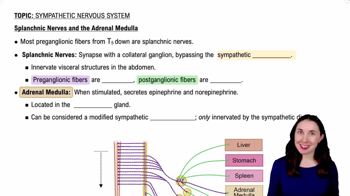
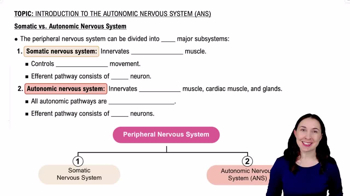
The autonomic nervous system (ANS) is a component of the peripheral nervous system that controls involuntary bodily functions, such as heart rate, digestion, and respiratory rate. It is divided into the sympathetic and parasympathetic systems, which work together to maintain balance in the body. In the context of blood pressure regulation, the sympathetic system typically increases heart rate and constricts blood vessels, while the parasympathetic system has the opposite effect.