
Textbook Question
Mark the following statements as true or false. If the statement is false, correct it to make a true statement.
The rhomboid major and minor muscles retract the scapula.
800
views
 Verified step by step guidance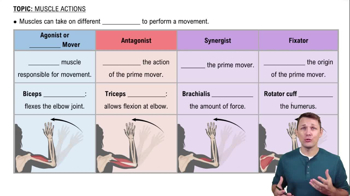
 5:41
5:41
 2:31
2:31Mark the following statements as true or false. If the statement is false, correct it to make a true statement.
The rhomboid major and minor muscles retract the scapula.
Which of the following muscle groups is considered muscles of inspiration?
a. External intercostal muscles
b. Internal intercostal muscles
c. External oblique muscles
d. Internal oblique muscles
Match the muscle with its main action:
_____Sternocleidomastoid muscle
_____Transversus abdominis muscle
_____Internal oblique muscle
_____Rectus abdominis muscle
_____Splenius capitis muscle
_____Quadratus lumborum muscle.
a. Laterally flexes the trunk
b. Flexes the trunk
c. Compresses the abdominal cavity
d. Extends the vertebral column
e. Flexes the head
f. Extends the head
Which of the following is not a muscle of the rotator cuff?
a. Teres major muscle
b. Teres minor muscle
c. Subscapularis muscle
d. Infraspinatus muscle
e. Supraspinatus muscle
Mark the following statements as true or false. If the statement is false, correct it to make a true statement.
The deltoid muscle is a main abductor of the forearm.
Mark the following statements as true or false. If the statement is false, correct it to make a true statement.
The latissimus dorsi muscle is a major abductor of the arm