The ultrastructure of a chloroplast is best studied using a
a. light microscope.
b. scanning electron microscope.
c. transmission electron microscope.
d. light microscope and fluorescent dyes.
Verified step by step guidance
1
Understand that the ultrastructure of a chloroplast refers to the detailed structure of the chloroplast at the molecular level.
Recognize that light microscopes have limitations in resolution and may not provide the detailed view needed for studying ultrastructures.
Consider that scanning electron microscopes (SEM) provide detailed surface images but are not typically used for internal structures.
Note that transmission electron microscopes (TEM) are designed to view thin sections of specimens and can reveal detailed internal structures, making them suitable for studying ultrastructures.
Evaluate the options and identify that the transmission electron microscope (TEM) is the most appropriate tool for studying the ultrastructure of a chloroplast.
Verified video answer for a similar problem:
This video solution was recommended by our tutors as helpful for the problem above.
Video duration:
1m
Play a video:
0 Comments
Key Concepts
Here are the essential concepts you must grasp in order to answer the question correctly.
Chloroplast Ultrastructure
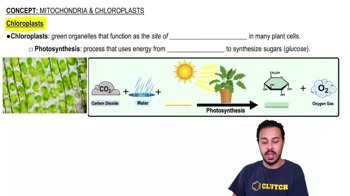
Chloroplasts are organelles found in plant cells responsible for photosynthesis. Their ultrastructure includes various components such as thylakoids, stroma, and outer membranes, which can be studied to understand their function in energy conversion. Analyzing these structures requires specific imaging techniques that can resolve fine details.
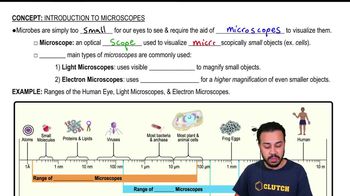
Different microscopy techniques offer varying levels of resolution and detail. Light microscopes provide basic imaging of cells but cannot resolve structures smaller than the wavelength of light. In contrast, electron microscopes, such as scanning and transmission types, use electron beams to achieve much higher resolutions, allowing for detailed visualization of cellular ultrastructure.
Resolution refers to the ability of a microscope to distinguish between two closely spaced objects. Higher resolution is crucial for studying ultrastructures like chloroplasts, as it allows scientists to see fine details that are essential for understanding their function. Transmission electron microscopes, in particular, provide the highest resolution, making them ideal for examining the intricate structures within chloroplasts.

 1:31 minutes
 Verified step by step guidance
 03:15
03:15