The chorionic villi (a) Form the umbilical cord (b) Form the umbilical vein (c) Form the umbilical arteries (d) Increase the surface area available for exchange between the placenta and maternal blood (e) Form the portion of the placenta called the capsular decidua
Verified step by step guidance
1
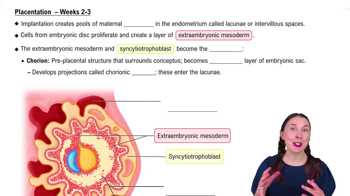
Understand the role of chorionic villi in fetal development. Chorionic villi are finger-like projections that extend from the chorion, one of the fetal membranes.
Recall that the primary function of chorionic villi is related to exchange processes between the mother and fetus, specifically facilitating nutrient and gas exchange.
Analyze each option: (a) The umbilical cord is formed by the connecting stalk and contains blood vessels, not directly by chorionic villi; (b) The umbilical vein carries oxygenated blood from the placenta to the fetus but is not formed by chorionic villi; (c) The umbilical arteries carry deoxygenated blood from the fetus to the placenta and are not formed by chorionic villi; (d) Chorionic villi increase the surface area for exchange between maternal blood and fetal blood in the placenta; (e) The capsular decidua is a maternal tissue layer, not formed by chorionic villi.
Conclude that the correct function of chorionic villi is to increase the surface area available for exchange between the placenta and maternal blood, which corresponds to option (d).
Summarize that chorionic villi are essential for maximizing the efficiency of nutrient, gas, and waste exchange by increasing the contact area between fetal and maternal blood supplies.
Verified video answer for a similar problem:
This video solution was recommended by our tutors as helpful for the problem above
Play a video:
Was this helpful?
Key Concepts
Here are the essential concepts you must grasp in order to answer the question correctly.
Chorionic Villi Structure and Function
Chorionic villi are finger-like projections of the chorion that extend into the maternal endometrium. Their primary role is to increase the surface area for exchange of gases, nutrients, and waste between fetal and maternal blood, facilitating efficient placental function.
The placenta consists of fetal and maternal parts; the fetal part includes the chorionic villi, while the maternal part includes the decidua basalis. Understanding which structures form the umbilical cord, veins, arteries, and decidua is essential to distinguish their origins and functions.
The umbilical cord contains two arteries and one vein that connect the fetus to the placenta. These vessels develop from the allantois and mesodermal core of the chorionic villi but are distinct from the villi themselves, which mainly serve as exchange surfaces rather than forming the vessels.