Trace the path of milk flow from its site of production to outside the female.
Verified step by step guidance
1
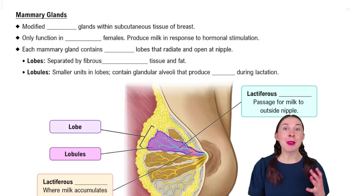
Start by identifying the site of milk production, which is the alveoli within the mammary glands. These small sac-like structures are lined with milk-secreting epithelial cells.
Next, understand that milk flows from the alveoli into small channels called lactiferous ducts. These ducts collect milk from multiple alveoli.
The lactiferous ducts then converge and widen into lactiferous sinuses, which serve as reservoirs where milk is stored temporarily before release.
From the lactiferous sinuses, milk travels through the nipple via the openings of the lactiferous ducts, which are located at the tip of the nipple.
Finally, milk exits the female body through the nipple openings during the process of breastfeeding or milk ejection, which is stimulated by the hormone oxytocin.
Verified video answer for a similar problem:
This video solution was recommended by our tutors as helpful for the problem above
Play a video:
Was this helpful?
Key Concepts
Here are the essential concepts you must grasp in order to answer the question correctly.
Mammary Gland Anatomy
The mammary gland is the site of milk production, consisting of alveoli where milk is synthesized by specialized epithelial cells. Understanding its structure, including lobules and ducts, is essential to trace milk flow.
Milk moves from alveoli into small ducts, then larger ducts, and finally into the gland cistern. The process involves milk ejection reflex triggered by oxytocin, which contracts myoepithelial cells to push milk through the duct system.
From the gland cistern, milk flows into the teat cistern and then through the teat canal, which acts as a passageway to the outside. The teat sphincter controls milk release and prevents contamination, completing the milk flow path.