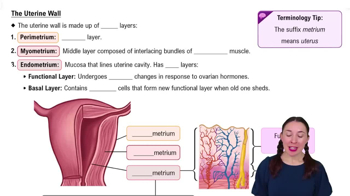
Begin by identifying the three main layers of the uterine wall: the endometrium, the myometrium, and the perimetrium.
Describe the endometrium, which is the innermost mucosal layer. Explain that it consists of a simple columnar epithelium lining and a thick underlying lamina propria made of connective tissue, containing uterine glands and blood vessels.
Explain the myometrium, the middle and thickest layer, composed primarily of smooth muscle fibers arranged in multiple directions, which allows for powerful contractions during labor.
Describe the perimetrium, the outermost layer, which is a serous membrane made of simple squamous epithelium (mesothelium) and a thin layer of connective tissue, covering the uterus externally.
Mention the functional significance of these layers, such as the cyclical changes in the endometrium during the menstrual cycle and the contractile role of the myometrium.
Verified video answer for a similar problem:
This video solution was recommended by our tutors as helpful for the problem above
Play a video:
Was this helpful?
Key Concepts
Here are the essential concepts you must grasp in order to answer the question correctly.
Layers of the Uterine Wall
The uterine wall consists of three main layers: the endometrium (inner lining), the myometrium (thick muscular middle layer), and the perimetrium (outer serous layer). Each layer has distinct histological features and functions essential for uterine physiology.
The endometrium is a mucous membrane composed of a simple columnar epithelium and underlying stroma. It undergoes cyclic changes during the menstrual cycle, preparing for potential embryo implantation and shedding during menstruation.
The myometrium is primarily made of smooth muscle fibers arranged in multiple layers, providing contractile strength for childbirth. It also contains blood vessels and connective tissue, supporting uterine expansion and contraction.