
Textbook Question
Mark the following statements as true or false. If a statement is false, correct is to make a true statement.
The secondary immune response is mediated by plasma cells.
1020
views

 Verified step by step guidance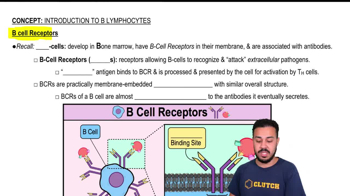
 4:37
4:37 4:37
4:37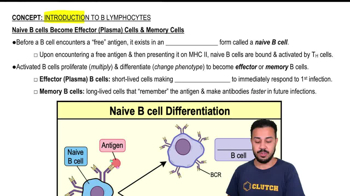 4:23
4:23Mark the following statements as true or false. If a statement is false, correct is to make a true statement.
The secondary immune response is mediated by plasma cells.
Mark the following statements as true or false. If a statement is false, correct is to make a true statement.
In the primary immune response, the lag phase lasts about 5 days, during which time B cells proliferate and differentiate.
Mark the following statements as true or false. If a statement is false, correct it to make a true statement.
Fever is generated by pyrogens that reset the temperature set point of the hypothalamus to a lower value.
Injured tissue releases chemicals called______ that mediate the four cardinal signs of inflammation, which are _____, ______,_____ , and_______.
Match the following antibodies with the correct definition.
____IgD
____IgM
____IgG
____IgA
____IgE
a. Antibody found in secretions
b. Most common antibody; crosses the placenta
c. Antibody involved in allergies and parasitic infections
d. Pentamer and potent agglutinating agent
e. Antibody bound to the B cell plasma membrane
Which of the following functions is/are performed by complement proteins?
a. Cell lysis
b. Opsonization
c. Enhancing inflammation
d. Only a and b
e. All of the above