How do true, false, and floating ribs differ from one another?
Verified step by step guidance
1
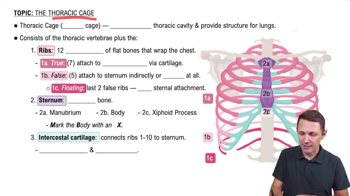
Understand the anatomical structure of the rib cage: The human rib cage consists of 12 pairs of ribs that are attached to the thoracic vertebrae in the spine. These ribs are categorized into three types: true ribs, false ribs, and floating ribs.
Define true ribs: True ribs are the first seven pairs of ribs (1–7). They are directly attached to the sternum (breastbone) via their own costal cartilage, which provides structural support and protection to vital organs like the heart and lungs.
Define false ribs: False ribs are the next three pairs of ribs (8–10). Unlike true ribs, they do not directly attach to the sternum. Instead, their costal cartilage connects to the cartilage of the ribs above them, forming an indirect connection to the sternum.
Define floating ribs: Floating ribs are the last two pairs of ribs (11–12). They are called 'floating' because they do not attach to the sternum or to other ribs. Their anterior ends are free, and they provide some protection to the kidneys located posteriorly.
Summarize the differences: True ribs are directly attached to the sternum, false ribs are indirectly attached via shared cartilage, and floating ribs have no attachment to the sternum. This classification reflects their structural and functional roles in the rib cage.
Verified video answer for a similar problem:
This video solution was recommended by our tutors as helpful for the problem above
Play a video:
Was this helpful?
Key Concepts
Here are the essential concepts you must grasp in order to answer the question correctly.
Rib Anatomy
Ribs are curved bones that form the rib cage, protecting vital organs in the thoracic cavity. There are 12 pairs of ribs in humans, categorized into three types: true ribs, false ribs, and floating ribs, each differing in their attachment to the sternum and vertebrae.
True ribs, or vertebrosternal ribs, are the first seven pairs of ribs that attach directly to the sternum via costal cartilage. This direct connection provides structural support and stability to the rib cage, allowing for effective respiratory mechanics.
False ribs include the 8th to 10th pairs, which do not attach directly to the sternum but connect to the 7th rib's cartilage. Floating ribs, the 11th and 12th pairs, do not attach to the sternum at all, providing less structural support and allowing for greater flexibility in the lower rib cage.