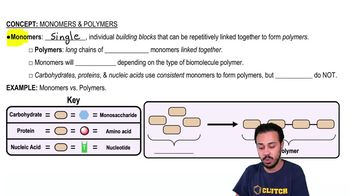
The molecular formula for glucose is C6H12O6. What would be the molecular formula for a polymer made by linking ten glucose molecules together by dehydration reactions?
a. C60H120O60
b. C60H102O51
c. C60H100O50
d. C60H111O51
Verified step by step guidance
1
Understand that dehydration reactions involve the removal of a water molecule (H2O) for each bond formed between glucose molecules.
Calculate the number of water molecules removed when linking ten glucose molecules. Since each bond removes one water molecule, and there are nine bonds formed between ten glucose molecules, nine water molecules are removed.
Determine the total number of carbon (C), hydrogen (H), and oxygen (O) atoms in ten glucose molecules before dehydration. This would be 10 times the number of each atom in one glucose molecule: C: 10 * 6, H: 10 * 12, O: 10 * 6.
Subtract the atoms of the water molecules removed from the total atoms calculated in the previous step. Each water molecule removed consists of 2 hydrogen atoms and 1 oxygen atom, so for nine water molecules, subtract 18 hydrogen atoms and 9 oxygen atoms.
Write the new molecular formula using the adjusted number of carbon, hydrogen, and oxygen atoms after accounting for the dehydration reactions.
Verified video answer for a similar problem:
This video solution was recommended by our tutors as helpful for the problem above.
Video duration:
46s
Play a video:
0 Comments
Key Concepts
Here are the essential concepts you must grasp in order to answer the question correctly.
Dehydration Reaction
A dehydration reaction, also known as a condensation reaction, is a chemical process where two molecules combine to form a larger molecule, releasing a water molecule in the process. In the context of glucose, when multiple glucose units link together, each bond formation results in the loss of a water molecule, which is crucial for understanding how polymers are formed from monomers.
Polymer formation refers to the process of creating large molecules (polymers) from smaller units (monomers) through repeated chemical reactions. In this case, linking ten glucose molecules together results in a polysaccharide, where the overall molecular formula must account for the number of monomers and the water molecules lost during the dehydration reactions.
The molecular formula represents the number and type of atoms in a molecule. To calculate the molecular formula of the polymer formed from ten glucose molecules, one must consider the initial formula of glucose (C6H12O6) and subtract the water molecules produced during the dehydration reactions. This involves understanding how to adjust the counts of carbon, hydrogen, and oxygen atoms accordingly.

 0:46 minutes
 Verified step by step guidance
 01:56
01:56