Membrane junctions that allow nutrients or ions to flow from cell to cell are: a. Desmosomes b. Gap junctions c. Tight junctions d. All of these
Verified step by step guidance
1
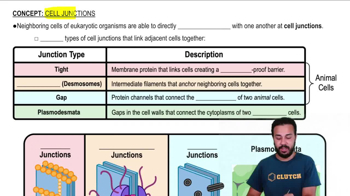
Step 1: Understand the types of membrane junctions mentioned. Desmosomes are strong adhesive junctions that hold cells together, providing mechanical stability but do not allow substances to pass through.
Step 2: Recognize that tight junctions create a seal between adjacent cells to prevent the passage of molecules and ions through the space between cells, effectively blocking flow.
Step 3: Identify that gap junctions are specialized connections that form channels between adjacent cells, allowing the direct passage of ions, nutrients, and small molecules from one cell to another.
Step 4: Compare the functions of each junction type to determine which one specifically allows the flow of nutrients or ions between cells.
Step 5: Conclude that the membrane junctions allowing nutrients or ions to flow from cell to cell are gap junctions.
Verified video answer for a similar problem:
This video solution was recommended by our tutors as helpful for the problem above
Video duration:
3m
Play a video:
Was this helpful?
Key Concepts
Here are the essential concepts you must grasp in order to answer the question correctly.
Gap Junctions
Gap junctions are specialized membrane junctions that form channels between adjacent cells, allowing direct passage of ions, nutrients, and small molecules. They enable rapid communication and coordination between cells, essential in tissues like cardiac and smooth muscle.
Desmosomes are strong adhesive junctions that mechanically link adjacent cells, providing structural stability. They do not allow the passage of substances between cells but help tissues resist mechanical stress, especially in skin and heart muscle.
Tight junctions create a seal between adjacent cells, preventing the leakage of substances through the space between cells. They maintain distinct compartments by controlling paracellular transport, crucial in epithelial layers like the intestines.