Adult cell types you might expect to have gap junctions include: a. Skeletal muscle b. Bone c. Heart muscle d. Smooth muscle
Verified step by step guidance
1
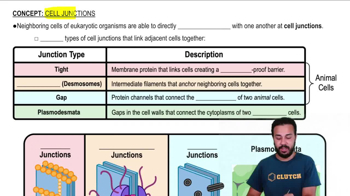
Understand the concept of gap junctions: Gap junctions are specialized intercellular connections that allow direct communication between cells. They enable the passage of ions, small molecules, and electrical signals, which is crucial for coordinated activity in certain tissues.
Analyze the function of skeletal muscle: Skeletal muscle cells are primarily controlled by the nervous system and do not rely on gap junctions for communication. Instead, they use neuromuscular junctions for signal transmission.
Evaluate the role of gap junctions in bone tissue: Bone cells (osteocytes) communicate through canaliculi and not gap junctions. While some signaling occurs between bone cells, gap junctions are not a primary feature of bone tissue.
Examine heart muscle (cardiac muscle): Cardiac muscle cells rely heavily on gap junctions to propagate electrical signals for synchronized contraction. This is essential for the heart's rhythmic pumping action.
Consider smooth muscle: Smooth muscle cells often use gap junctions to coordinate contractions, especially in organs like the intestines and blood vessels, where synchronized activity is necessary for function.
Verified video answer for a similar problem:
This video solution was recommended by our tutors as helpful for the problem above
Video duration:
3m
Play a video:
Was this helpful?
Key Concepts
Here are the essential concepts you must grasp in order to answer the question correctly.
Gap Junctions
Gap junctions are specialized intercellular connections that allow direct communication between adjacent cells. They consist of protein channels called connexons, which enable the transfer of ions and small molecules, facilitating coordinated activities such as muscle contraction and electrical signaling.
Muscle tissue is categorized into three types: skeletal, cardiac, and smooth. Skeletal muscle is voluntary and striated, cardiac muscle is involuntary and striated, and smooth muscle is involuntary and non-striated. Understanding these types is crucial for identifying where gap junctions are present.
In muscle tissues, gap junctions play a vital role in synchronizing contractions. For instance, in cardiac muscle, gap junctions allow for the rapid spread of electrical impulses, ensuring that the heart beats in a coordinated manner. This function is less critical in skeletal muscle, which relies on neuromuscular junctions for contraction.