
Ch. 24 The Urinary System
Amerman - Human Anatomy & Physiology 2nd Edition
Amerman2nd EditionHuman Anatomy & PhysiologyISBN: 9780136873822Not the one you use?Change textbook
Chapter 24, Problem L3.2

Mr. Gupta has been diagnosed with nephrotic syndrome, which is characterized by the loss of plasma proteins such as albumin into the urine. What impact will this have on his colloid osmotic pressure? How will this affect the net filtration pressure in his capillary beds? What effect will this likely cause?

Verified step by step guidance
1
Understand the role of colloid osmotic pressure: Colloid osmotic pressure is primarily maintained by plasma proteins like albumin. These proteins exert a pulling force that helps retain water in the capillaries, opposing the outward hydrostatic pressure.
Analyze the impact of albumin loss: In nephrotic syndrome, albumin is lost in the urine, reducing its concentration in the blood. This decrease in plasma protein levels lowers the colloid osmotic pressure, diminishing the ability of the capillaries to retain water.
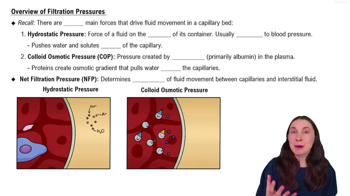
Examine the effect on net filtration pressure: Net filtration pressure is determined by the balance between hydrostatic pressure (pushing fluid out of capillaries) and colloid osmotic pressure (pulling fluid into capillaries). A reduction in colloid osmotic pressure will increase the net filtration pressure, favoring fluid movement out of the capillaries into the interstitial space.
Consider the physiological consequences: The increased net filtration pressure can lead to excessive fluid accumulation in the interstitial spaces, causing edema (swelling) in tissues. This is a common symptom in patients with nephrotic syndrome.
Relate the findings to the clinical presentation: The loss of plasma proteins and subsequent edema are key features of nephrotic syndrome. Understanding this mechanism helps explain why patients like Mr. Gupta experience swelling and other related symptoms.

Verified video answer for a similar problem:

This video solution was recommended by our tutors as helpful for the problem above.
Was this helpful?

Key Concepts

Here are the essential concepts you must grasp in order to answer the question correctly.

Colloid Osmotic Pressure

Colloid osmotic pressure is the pressure exerted by proteins, particularly albumin, in the blood plasma that helps to retain water within the circulatory system. In nephrotic syndrome, the loss of these proteins into the urine decreases the colloid osmotic pressure, leading to a reduced ability to draw water back into the bloodstream from the interstitial spaces.
Recommended video:
Guided course
6:12
Partial Pressure

Net Filtration Pressure

Net filtration pressure (NFP) is the difference between the hydrostatic pressure in the capillaries and the osmotic pressure exerted by the plasma proteins. A decrease in colloid osmotic pressure, as seen in nephrotic syndrome, reduces NFP, which can lead to less fluid being reabsorbed into the capillaries and more fluid remaining in the interstitial space.
Recommended video:
2:58
Overview of Filtration Pressures

Edema

Edema is the accumulation of excess fluid in the interstitial spaces, often resulting from imbalances in hydrostatic and osmotic pressures. In the case of nephrotic syndrome, the decreased colloid osmotic pressure leads to increased fluid leakage from capillaries, causing swelling and fluid retention in tissues, which is a common symptom of the condition.
Recommended video:
3:15
Glomerular Filtration Rate
Related Practice
Textbook Question

Drugs that treat hypertension, or high blood pressure, have the following actions. Discuss the specific effect that each drug will have on the kidneys.

b. Blocking the receptor for angiotensin-II on blood vessels and in the renal tubule cells

614
views
Textbook Question

Explain how each of the drugs in question 1 from this section would lower blood pressure.

803
views
Textbook Question

Deana is a 4-year-old girl with a rare genetic defect that causes the Na+/glucose symporters in the proximal tubule to reabsorb fewer glucose and sodium ions than normal. Predict the effects this defect will have on the composition and volume of Deana's urine. Explain why you would expect to see increased activity of the tubuloglomerular feedback and the renin-angiotensin-aldosterone system in Deana's kidneys.

705
views
Textbook Question

Mark the following statements as true or false. If a statement is false, correct it to make a true statement.

a. The kidneys are retroperitoneal and covered by three layers of connective tissue.

803
views
1
rank
Textbook Question

Drugs that treat hypertension, or high blood pressure, have the following actions. Discuss the specific effect that each drug will have on the kidneys.

c. Blocking the Na+/Cl−/2K+ transport pumps in the thick ascending limb of the nephron loop

478
views
Textbook Question

Drugs that treat hypertension, or high blood pressure, have the following actions. Discuss the specific effect that each drug will have on the kidneys.

a. Blocking the action of aldosterone on the kidneys

665
views