What are the differences between pulmonary volumes and respiratory capacities? How are pulmonary volumes and respiratory capacities determined?
Verified step by step guidance
1
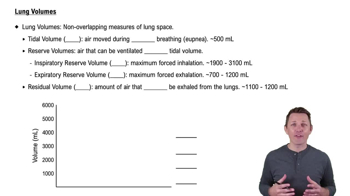
Understand the definitions: Pulmonary volumes refer to the specific amounts of air that move in and out of the lungs during different phases of breathing, such as tidal volume (TV), inspiratory reserve volume (IRV), expiratory reserve volume (ERV), and residual volume (RV). Respiratory capacities are combinations of two or more pulmonary volumes, such as vital capacity (VC), total lung capacity (TLC), inspiratory capacity (IC), and functional residual capacity (FRC).
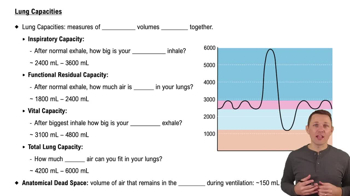
Learn the differences: Pulmonary volumes are individual measurements of air, while respiratory capacities represent the sum of specific pulmonary volumes. For example, vital capacity (VC) is the sum of tidal volume (TV), inspiratory reserve volume (IRV), and expiratory reserve volume (ERV).
Understand how pulmonary volumes are measured: Pulmonary volumes are typically determined using a spirometer, a device that measures the amount of air inhaled and exhaled during breathing. Residual volume (RV), which cannot be directly measured by spirometry, is estimated using techniques like gas dilution or body plethysmography.
Understand how respiratory capacities are calculated: Respiratory capacities are derived by adding specific pulmonary volumes together. For example, total lung capacity (TLC) is calculated as the sum of all pulmonary volumes: tidal volume (TV) + inspiratory reserve volume (IRV) + expiratory reserve volume (ERV) + residual volume (RV).
Recognize the clinical relevance: Pulmonary volumes and respiratory capacities are essential for assessing lung function and diagnosing respiratory conditions. Abnormal values can indicate issues such as obstructive or restrictive lung diseases, and these measurements are often used in pulmonary function tests (PFTs).
Verified video answer for a similar problem:
This video solution was recommended by our tutors as helpful for the problem above
Play a video:
Was this helpful?
Key Concepts
Here are the essential concepts you must grasp in order to answer the question correctly.
Pulmonary Volumes
Pulmonary volumes refer to the specific measurements of air that can be inhaled or exhaled from the lungs during different phases of the respiratory cycle. These include tidal volume (the amount of air inhaled or exhaled in a normal breath), inspiratory reserve volume, expiratory reserve volume, and residual volume. Understanding these volumes is essential for assessing lung function and diagnosing respiratory conditions.
Respiratory capacities are derived from the combination of two or more pulmonary volumes and provide a broader understanding of lung function. Key capacities include vital capacity (the maximum amount of air exhaled after a maximum inhalation) and total lung capacity (the total volume of air the lungs can hold). These capacities help in evaluating the overall respiratory health and efficiency of the lungs.
Pulmonary volumes and respiratory capacities are typically measured using spirometry, a common pulmonary function test. This test involves the patient breathing into a device that records the amount and rate of air inhaled and exhaled. Understanding the techniques and tools used for these measurements is crucial for interpreting results and diagnosing potential respiratory issues.