In glycolysis, ________ is oxidized and ________ is reduced.a. NAD+ ... glucoseb. glucose ... oxygenc. ATP ... ADPd. glucose ... NAD+
Verified step by step guidance
1
Step 1: Understand the process of glycolysis, which is the metabolic pathway that converts glucose into pyruvate, releasing energy and reducing equivalents in the form of NADH.
Step 2: Identify the role of glucose in glycolysis. Glucose is the initial substrate that undergoes oxidation, losing electrons as it is converted into pyruvate.
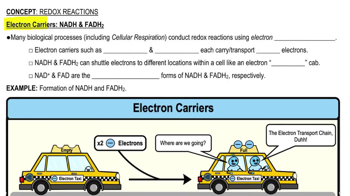
Step 3: Recognize the role of NAD+ in glycolysis. NAD+ acts as an electron carrier and is reduced to NADH as it accepts electrons during the oxidation of glucose.
Step 4: Analyze the options given in the problem. Determine which option correctly identifies the substance that is oxidized and the substance that is reduced.
Step 5: Conclude that in glycolysis, glucose is oxidized and NAD+ is reduced, matching this understanding with the correct option from the list provided.
Verified video answer for a similar problem:
This video solution was recommended by our tutors as helpful for the problem above
Video duration:
3m
Play a video:
Was this helpful?
Key Concepts
Here are the essential concepts you must grasp in order to answer the question correctly.
Glycolysis
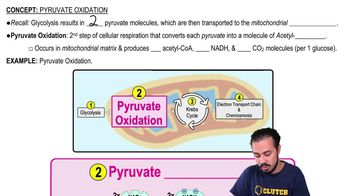
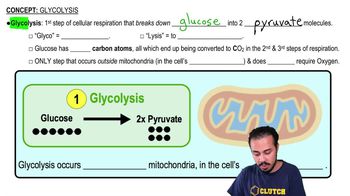
Glycolysis is a metabolic pathway that converts glucose into pyruvate, producing a small amount of ATP and NADH in the process. It occurs in the cytoplasm of cells and is the first step in cellular respiration. Understanding glycolysis is essential for identifying which substances are oxidized and reduced during the reaction.
Oxidation refers to the loss of electrons or an increase in oxidation state by a molecule, while reduction is the gain of electrons or a decrease in oxidation state. In glycolysis, glucose is oxidized to form pyruvate, and NAD+ is reduced to NADH. Recognizing these processes is crucial for answering questions about the electron transfer in metabolic pathways.
NAD+ (Nicotinamide adenine dinucleotide) is a coenzyme that acts as an electron carrier in various metabolic reactions, including glycolysis. When NAD+ accepts electrons during glycolysis, it is reduced to NADH. This conversion is vital for energy production, as NADH can later be used in the electron transport chain to generate ATP.