
Textbook Question
Mark the following statements as true or false. If a statement is false, correct is to make a true statement.
d. Vaccinations are given to induce the production of the inflammatory response.
1105
views

 Verified step by step guidance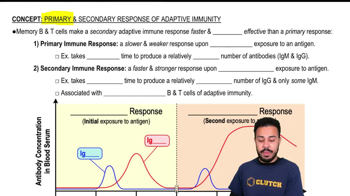
 6:59
6:59
 4:23 4:23
Mark the following statements as true or false. If a statement is false, correct is to make a true statement.
d. Vaccinations are given to induce the production of the inflammatory response.
Mark the following statements as true or false. If a statement is false, correct is to make a true statement.
Subunit vaccines consist of pathogens that are alive but unable to cause disease.
Mark the following statements as true or false. If a statement is false, correct is to make a true statement.
In the primary immune response, the lag phase lasts about 5 days, during which time B cells proliferate and differentiate.
Explain how active immunity and passive immunity differ.
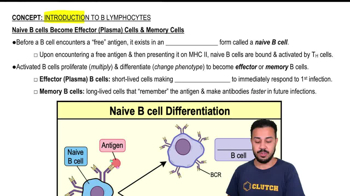
When naïve B cells are activated, they differentiate into:
a. Plasma cells
b. Memory cells
c. Both a and b
d. None of the above
Match the following antibodies with the correct definition.
____IgD
____IgM
____IgG
____IgA
____IgE
a. Antibody found in secretions
b. Most common antibody; crosses the placenta
c. Antibody involved in allergies and parasitic infections
d. Pentamer and potent agglutinating agent
e. Antibody bound to the B cell plasma membrane