A cell that is placed in salty seawater will .a. take sodium and chloride ions in by diffusion;b. move water out of the cell by active transport;c. use facilitated diffusion to break apart the sodium and chloride ions;d. lose water to the outside of the cell via osmosis
Verified step by step guidance
1
Identify the type of solution the cell is placed in. Salty seawater is a hypertonic solution compared to the cell's internal environment.
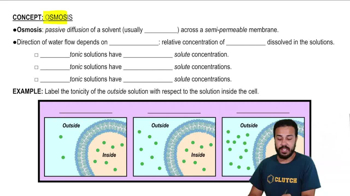
Understand the concept of osmosis, which is the movement of water across a semipermeable membrane from an area of lower solute concentration to an area of higher solute concentration.
Recognize that in a hypertonic solution, water will move out of the cell to balance the solute concentrations on both sides of the cell membrane.
Consider the options given: a) involves diffusion of ions, b) involves active transport, c) involves facilitated diffusion, and d) involves osmosis.
Determine that the correct process occurring is osmosis, where the cell loses water to the outside environment, which corresponds to option d.
Was this helpful?
Key Concepts
Here are the essential concepts you must grasp in order to answer the question correctly.
Osmosis
Osmosis is the movement of water molecules across a selectively permeable membrane from an area of lower solute concentration to an area of higher solute concentration. In the context of a cell in salty seawater, osmosis explains how water will move out of the cell to balance the higher concentration of solutes (salt) outside the cell, leading to cell shrinkage.
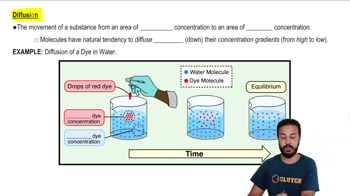
Diffusion is the process by which molecules spread from areas of high concentration to areas of low concentration. In the case of a cell in salty seawater, sodium and chloride ions may diffuse into the cell if the concentration of these ions is lower inside the cell compared to the surrounding seawater, although this is not the primary effect in this scenario.
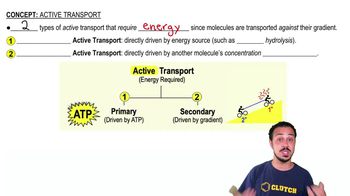
Active transport is the movement of ions or molecules across a cell membrane against their concentration gradient, requiring energy, usually in the form of ATP. While active transport is crucial for maintaining cellular homeostasis, in the context of a cell in salty seawater, it is not the primary mechanism at play for water movement, which is primarily driven by osmosis.