Analyze the following statements about DNA synthesis. Select True or False for each statement.
T/FAn RNA polymerase is essential for DNA synthesis.
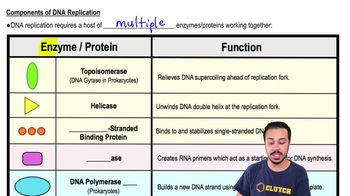
T/FOkazaki fragments would be unnecessary if DNA polymerase could synthesize DNA in both the 3'→5' and 5'→3' directions.
T/FDNA ligase is used more frequently on the lagging strand than on the leading strand.
T/FToposiomerase is required to separate the two strands of DNA at the replication fork.
Verified step by step guidance
1
Identify the role of RNA polymerase in DNA synthesis. RNA polymerase is primarily involved in transcription, not DNA replication, so consider whether it is essential for DNA synthesis.
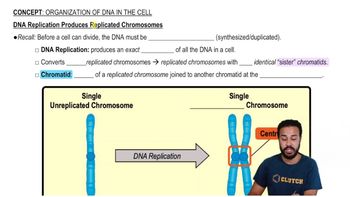
Understand the function of Okazaki fragments. These are short sequences synthesized on the lagging strand during DNA replication because DNA polymerase can only synthesize in the 5'→3' direction. Consider if they would be needed if synthesis could occur in both directions.
Examine the role of DNA ligase. It joins Okazaki fragments on the lagging strand, so determine if it is used more frequently on the lagging strand compared to the leading strand.
Consider the function of topoisomerase. It alleviates the tension created by unwinding the DNA helix, but does it directly separate the strands at the replication fork?
Evaluate each statement based on the understanding of the roles of RNA polymerase, Okazaki fragments, DNA ligase, and topoisomerase in DNA replication.
Verified video answer for a similar problem:
This video solution was recommended by our tutors as helpful for the problem above.
Video duration:
1m
Play a video:
0 Comments
Key Concepts
Here are the essential concepts you must grasp in order to answer the question correctly.
DNA Synthesis
DNA synthesis is the biological process by which a cell replicates its DNA, ensuring that each daughter cell receives an identical copy of the genetic material. This process involves several key enzymes, including DNA polymerase, which synthesizes new DNA strands by adding nucleotides complementary to the template strand. Understanding the directionality of synthesis (5' to 3') is crucial, as it influences how the leading and lagging strands are formed during replication.
Okazaki fragments are short sequences of DNA synthesized on the lagging strand during DNA replication. Because DNA polymerase can only synthesize DNA in the 5' to 3' direction, the lagging strand is synthesized discontinuously, resulting in these fragments. Each fragment is later joined together by DNA ligase, making the understanding of their formation essential for grasping the overall mechanism of DNA replication.
Various enzymes play critical roles in DNA replication, including RNA polymerase, DNA ligase, and topoisomerase. RNA polymerase is involved in synthesizing RNA primers necessary for DNA polymerase to initiate synthesis. DNA ligase connects Okazaki fragments on the lagging strand, while topoisomerase alleviates the torsional strain generated ahead of the replication fork by unwinding the DNA helix. Each enzyme's function is vital for the accuracy and efficiency of DNA replication.

 1:06 minutes
 Verified step by step guidance
 05:13
05:13