
Textbook Question
Mark the following statements as true or false. If the statement is false, correct it to make it a true statement.
Substances can move toward or away from the cell body through the axon via fast axonal transport.
893
views

 Verified step by step guidance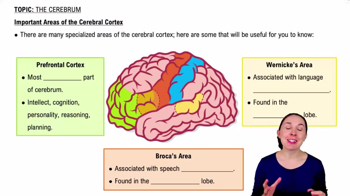
 3:15
3:15
 2:41
2:41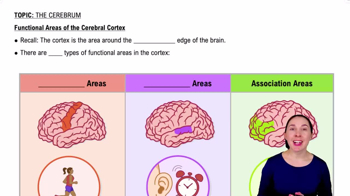 4:49
4:49Mark the following statements as true or false. If the statement is false, correct it to make it a true statement.
Substances can move toward or away from the cell body through the axon via fast axonal transport.
Mark the following statements about the cerebral cortex as true or false. If a statement is false, correct it to make a true statement.
The prefrontal cortex is located in the frontal lobe and is concerned with movement.
Mark the following statements about the cerebral cortex as true or false. If a statement is false, correct it to make a true statement.
The primary visual cortex is located in the occipital lobe.
An axon is best defined as a process that:
a. Transmits signals only toward the cell body.
b. Can generate action potentials.
c. Transmits signals only away from the cell body.
d. Cannot generate action potentials
Mark the following statements about the cerebral cortex as true or false. If a statement is false, correct it to make a true statement.
The neocortex is the 'newest' component of the cerebral cortex from an evolutionary perspective.
The myelinated segment of an axon that is covered by a glial cell is called a/an ________; the gaps between glial cells where the axolemma is exposed are called ________.