Ch. 9 The Endocrine System
Marieb - Essentials of Human Anatomy & Physiology 13th Edition
Marieb13th EditionEssentials of Human Anatomy & PhysiologyISBN: 9780135624340Not the one you use?Change textbook
Chapter 9, Problem 10

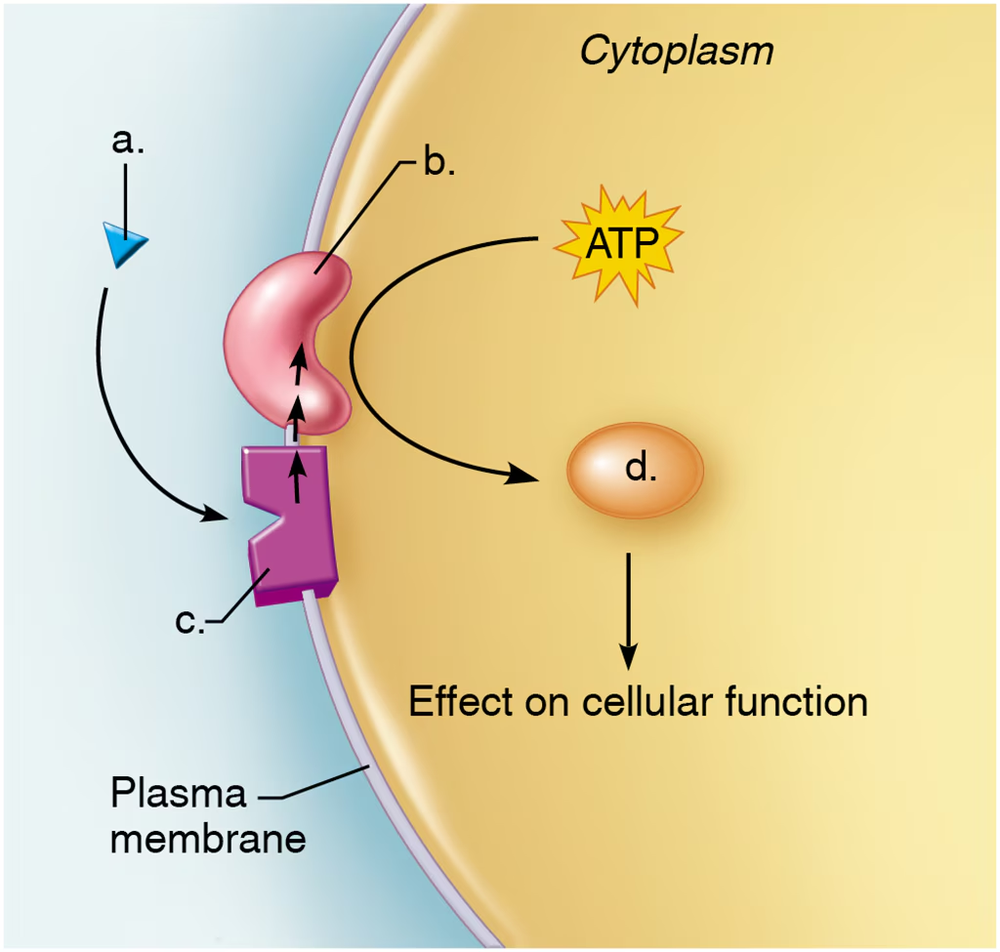
More than one choice may apply. In the hormone-signaling pathway represented in the figure,_________ is the first messenger, and _______is the second messenger that will signal a change in cell activity.
Diagram illustrating hormone signaling pathways, showing first and second messengers affecting cellular function.

Verified step by step guidance
1
Step 1: Understand the concept of hormone signaling pathways. Hormones act as chemical messengers that bind to specific receptors on target cells to initiate a response. The 'first messenger' is typically the hormone itself, which binds to the receptor on the cell membrane.
Step 2: Recognize the role of the 'second messenger.' Once the hormone (first messenger) binds to the receptor, it triggers a cascade of intracellular signaling events. The second messenger is a molecule inside the cell that amplifies the signal and leads to changes in cell activity.
Step 3: Review common examples of second messengers. These include cyclic AMP (cAMP), calcium ions (Ca²⁺), and inositol triphosphate (IP₃). These molecules are activated or released in response to the binding of the first messenger to its receptor.
Step 4: Analyze the figure provided in the problem. Identify the hormone acting as the first messenger and the intracellular molecule that serves as the second messenger. Look for labels or visual cues in the figure to determine these roles.
Step 5: Match the correct options (a, b, c, d) to the descriptions of the first and second messengers based on your analysis of the figure and your understanding of hormone signaling pathways.

Verified video answer for a similar problem:

This video solution was recommended by our tutors as helpful for the problem above.
Video duration:
3m
Was this helpful?

Key Concepts

Here are the essential concepts you must grasp in order to answer the question correctly.

First Messenger

The first messenger is a signaling molecule, typically a hormone or neurotransmitter, that binds to a specific receptor on the surface of a target cell. This binding initiates a cascade of intracellular events, leading to a physiological response. Examples include insulin and adrenaline, which trigger various cellular activities by interacting with their respective receptors.
Recommended video:
Guided course
10:41
Secondary Messengers

Second Messenger

Second messengers are intracellular signaling molecules released in response to the activation of a receptor by a first messenger. They amplify the signal and propagate the response within the cell, often leading to changes in gene expression, enzyme activity, or ion channel permeability. Common examples include cyclic AMP (cAMP) and calcium ions (Ca²⁺), which play crucial roles in various cellular processes.
Recommended video:
Guided course
10:41
Secondary Messengers

Signal Transduction Pathway

A signal transduction pathway is a series of molecular events and interactions that occur when a signaling molecule binds to a receptor, leading to a cellular response. This pathway often involves multiple steps, including the activation of second messengers, protein kinases, and other signaling proteins. Understanding these pathways is essential for comprehending how cells respond to external signals and regulate their functions.
Recommended video:
4:40
Alternative Pathway