Organic chemistry is currently defined as
a. the study of compounds made only by living cells.
b. the study of carbon compounds.
c. the study of natural (as opposed to synthetic) compounds.
d. the study of hydrocarbons.
Verified step by step guidance
1
Identify the key element that is central to organic chemistry, which is carbon.
Consider the broadest definition that encompasses all compounds studied in organic chemistry.
Evaluate each option: (a) focuses on compounds made by living cells, which is not entirely accurate as organic chemistry includes synthetic compounds as well; (b) involves carbon compounds, which is a fundamental aspect of organic chemistry; (c) distinguishes between natural and synthetic, which is not a defining feature of organic chemistry; (d) focuses on hydrocarbons, which are a subset of organic compounds.
Determine which option best describes the field of organic chemistry as a whole.
Conclude that the study of carbon compounds is the most comprehensive definition of organic chemistry.
Verified video answer for a similar problem:
This video solution was recommended by our tutors as helpful for the problem above.
Video duration:
2m
Play a video:
0 Comments
Key Concepts
Here are the essential concepts you must grasp in order to answer the question correctly.
Definition of Organic Chemistry
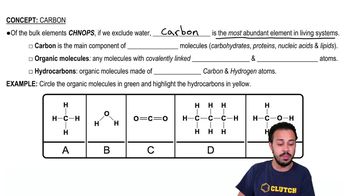
Organic chemistry is primarily defined as the study of carbon-containing compounds. This includes a vast array of substances, from simple molecules like methane to complex macromolecules such as proteins and nucleic acids. Understanding this definition is crucial as it distinguishes organic chemistry from other branches of chemistry that focus on inorganic compounds.
Carbon is unique in its ability to form stable bonds with many elements, including itself, leading to a diverse range of compounds. This versatility allows for the formation of various structures, such as chains, rings, and complex three-dimensional shapes. The study of these carbon compounds is central to organic chemistry, as they are the foundation of biological molecules and synthetic materials.
In organic chemistry, compounds can be classified as natural or synthetic. Natural compounds are those produced by living organisms, while synthetic compounds are artificially created in laboratories. This distinction is important for understanding the applications of organic chemistry in fields such as pharmaceuticals, where both types of compounds play significant roles in drug development and research.

 2:35 minutes
 Verified step by step guidance
 05:04
05:04