Mark the following statements as true or false. If a statement is false, correct it to make a true statement. Lipids contain oxygen and are therefore polar covalent compounds.
Verified step by step guidance
1
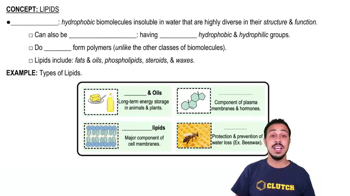
Step 1: Understand the composition of lipids. Lipids are primarily composed of carbon (C), hydrogen (H), and a small amount of oxygen (O). They are hydrophobic (nonpolar) molecules due to their long hydrocarbon chains, which dominate their structure.
Step 2: Analyze the statement. The statement claims that lipids contain oxygen and are therefore polar covalent compounds. While it is true that lipids may contain oxygen, their overall structure is largely nonpolar due to the dominance of hydrocarbon chains.
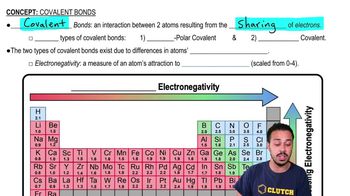
Step 3: Recall the definition of polar covalent compounds. Polar covalent compounds have an unequal sharing of electrons, leading to partial positive and negative charges. Lipids, however, do not exhibit this property in their hydrocarbon regions, making them nonpolar.
Step 4: Determine the truth of the statement. The statement is false because lipids are not polar covalent compounds despite containing oxygen. Their hydrophobic nature classifies them as nonpolar molecules.
Step 5: Correct the false statement. A corrected version of the statement would be: 'Lipids contain oxygen but are primarily nonpolar molecules due to their long hydrocarbon chains.'
Verified video answer for a similar problem:
This video solution was recommended by our tutors as helpful for the problem above
Play a video:
Was this helpful?
Key Concepts
Here are the essential concepts you must grasp in order to answer the question correctly.
Lipids
Lipids are a diverse group of hydrophobic organic molecules, primarily composed of carbon and hydrogen, with some containing oxygen. They include fats, oils, and phospholipids, which play crucial roles in energy storage, cellular structure, and signaling. Unlike polar covalent compounds, lipids are generally nonpolar, making them insoluble in water.
Polarity refers to the distribution of electrical charge over the atoms in a molecule. Polar molecules have a significant difference in electronegativity between bonded atoms, resulting in a partial positive and negative charge. In contrast, nonpolar molecules, like most lipids, have an even distribution of charge, leading to their hydrophobic nature.
Covalent bonds are formed when two atoms share electrons, allowing them to achieve stability. These bonds can be polar or nonpolar, depending on the electronegativity of the atoms involved. In the context of lipids, the majority of their bonds are nonpolar, contributing to their hydrophobic characteristics and their classification as nonpolar compounds.