DNA's primary structure is made up of just four different bases, and its secondary structure is regular and highly stable. How can a molecule with these characteristics hold the information required to build and maintain a cell?
Verified step by step guidance
1
Understand that DNA's primary structure consists of a sequence of four nucleotide bases: adenine (A), thymine (T), cytosine (C), and guanine (G).
Recognize that the sequence of these bases encodes genetic information, similar to how letters form words and sentences.
Consider the concept of complementary base pairing, where A pairs with T and C pairs with G, which is crucial for DNA replication and stability.
Explore how the sequence of bases in DNA is transcribed into RNA, which is then translated into proteins, the functional molecules in cells.
Reflect on the role of proteins in cellular functions, as they are responsible for catalyzing reactions, providing structural support, and regulating processes, thus maintaining the cell.
Verified video answer for a similar problem:
This video solution was recommended by our tutors as helpful for the problem above.
Video duration:
47s
Play a video:
0 Comments
Key Concepts
Here are the essential concepts you must grasp in order to answer the question correctly.
DNA Structure
DNA consists of a sequence of four nucleotide bases: adenine (A), thymine (T), cytosine (C), and guanine (G). The specific order of these bases encodes genetic information, with each sequence corresponding to different instructions for building proteins and regulating cellular functions.
The secondary structure of DNA is characterized by its double helix formation, where bases pair specifically (A with T and C with G) through hydrogen bonds. This complementary base pairing not only stabilizes the structure but also allows for accurate replication and transcription of genetic information.
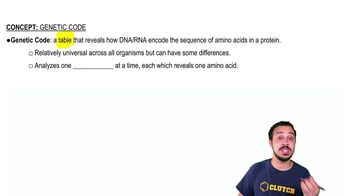
The genetic code is a set of rules that defines how sequences of nucleotide bases correspond to amino acids, the building blocks of proteins. This code is crucial for translating the information stored in DNA into functional proteins, which are essential for the growth, maintenance, and regulation of cellular activities.

 0:47 minutes
 Verified step by step guidance
 03:20
03:20