How could you tell the difference between an injury that damaged the cerebellum and one that damaged the basal nuclei?
Verified step by step guidance
1
Understand the primary functions of the cerebellum: The cerebellum is responsible for coordinating voluntary movements, maintaining balance, posture, and fine motor control. Damage to the cerebellum often results in issues such as ataxia (loss of coordination), tremors, and difficulty with precise movements.
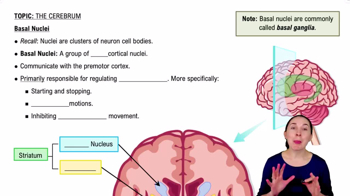
Understand the primary functions of the basal nuclei: The basal nuclei (or basal ganglia) are involved in regulating motor control, initiating voluntary movements, and inhibiting unwanted movements. Damage to the basal nuclei can lead to conditions such as Parkinson's disease or Huntington's disease, characterized by tremors, rigidity, or involuntary movements.
Compare symptoms of cerebellar damage: If the injury affects the cerebellum, you would expect symptoms such as difficulty maintaining balance, uncoordinated movements, slurred speech, or an inability to perform rapid alternating movements (dysdiadochokinesia). These symptoms are typically related to motor coordination and precision.
Compare symptoms of basal nuclei damage: If the injury affects the basal nuclei, you would expect symptoms such as resting tremors, bradykinesia (slowness of movement), rigidity, or involuntary movements like chorea (jerky, involuntary movements). These symptoms are more related to motor initiation and suppression.
Use diagnostic tests or observations to differentiate: Neurological exams, imaging studies (like MRI or CT scans), and observing specific motor impairments can help pinpoint the affected area. For example, testing coordination and balance may highlight cerebellar damage, while observing tremors or rigidity may indicate basal nuclei involvement.
Was this helpful?
Key Concepts
Here are the essential concepts you must grasp in order to answer the question correctly.
Cerebellum Function
The cerebellum is primarily responsible for coordinating voluntary movements, balance, and motor learning. It integrates sensory information to fine-tune motor activity, allowing for smooth and precise movements. Damage to the cerebellum often results in ataxia, characterized by uncoordinated movements and difficulties with balance.
The basal nuclei, or basal ganglia, are a group of nuclei in the brain involved in the regulation of voluntary motor control, procedural learning, and routine behaviors. They play a crucial role in the initiation and smooth execution of movements. Damage to the basal nuclei can lead to movement disorders such as Parkinson's disease, characterized by tremors, rigidity, and bradykinesia.
Differentiating between cerebellar and basal nuclei injuries involves assessing specific clinical symptoms. Cerebellar damage typically presents with issues in coordination and balance, while basal nuclei damage often results in abnormal movement patterns and rigidity. Neurological examinations, including gait analysis and motor function tests, can help identify the affected area based on these distinct symptoms.