
Textbook Question
Mark the following statements as true or false. If the statement is false, correct it to make it a true statement.
Aggregates of Golgi apparatus and lysosomes form dark-staining Nissl bodies within the cell body.
877
views
 Verified step by step guidance
 2:50
2:50
 04:19
04:19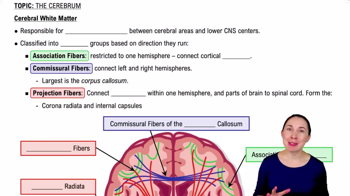 3:13
3:13Mark the following statements as true or false. If the statement is false, correct it to make it a true statement.
Aggregates of Golgi apparatus and lysosomes form dark-staining Nissl bodies within the cell body.
In a diving accident, Arlene damages the left side of her upper thoracic spinal cord. On which side of the body will she lose: muscle control, tactile sensation, and pain sensation? Explain.
On further examination, Ms. Norris is shown to be in a state of unarousable unconsciousness, or coma. Which area or system of the brain is likely damaged? Explain.
A new diet wonder drug is designed to block the release of orexins. How might this cause weight loss? Predict the potential adverse effects that might come from blocking orexin release.
Which statement about cerebral white matter is false?
a. Commissural fibers connect the right and left cerebral hemispheres.
b. Projection fibers connect the cerebral cortex of one hemisphere with structures in the other hemisphere.
c. The corpus callosum is the largest bundle of white matter in the brain.
d. Association fibers connect the gyri of the cerebral cortex with one another.
Mark the following statements as true or false. If the statement is false, correct it to make it a true statement.
The axon contains a high density of ribosomes, rough endoplasmic reticulum, and Golgi apparatus.