Which of these molecules would you predict to have the largest number of polar covalent bonds based on their molecular formulas?
a. C2H6O(ethanol)
b. C2H6(ethane)
c. C2H4O2(aceticacid)
d. C3H8O (propanol)
Verified step by step guidance
1
Identify the functional groups present in each molecule, as these often contain polar covalent bonds. For example, hydroxyl (-OH) and carboxyl (-COOH) groups are polar.
Analyze the molecular formula of each compound to determine the presence of these functional groups. Ethanol (C2H6O) and propanol (C3H8O) contain hydroxyl groups, while acetic acid (C2H4O2) contains both hydroxyl and carboxyl groups.
Consider the electronegativity differences between atoms in these functional groups. Oxygen is more electronegative than carbon and hydrogen, leading to polar covalent bonds in the hydroxyl and carboxyl groups.
Count the number of polar covalent bonds in each molecule. Ethanol and propanol each have one hydroxyl group, while acetic acid has one hydroxyl and one carboxyl group, potentially increasing the number of polar bonds.
Compare the total number of polar covalent bonds in each molecule to determine which has the largest number.
Verified video answer for a similar problem:
This video solution was recommended by our tutors as helpful for the problem above.
Video duration:
3m
Play a video:
0 Comments
Key Concepts
Here are the essential concepts you must grasp in order to answer the question correctly.
Polar Covalent Bonds
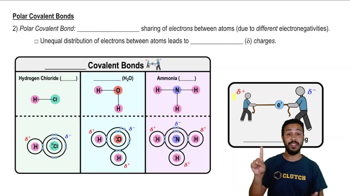
Polar covalent bonds occur when two atoms share electrons unequally due to a difference in electronegativity. This results in a partial positive charge on one atom and a partial negative charge on the other, creating a dipole. Molecules with polar covalent bonds often have functional groups like -OH (hydroxyl) or -COOH (carboxyl), which significantly influence their chemical properties and interactions.
A molecular formula provides information about the number and types of atoms in a molecule, which can help predict the presence of polar covalent bonds. By analyzing the formula, one can identify functional groups that typically contain polar bonds. For example, the presence of oxygen or nitrogen atoms often indicates potential polar covalent bonding due to their higher electronegativity compared to carbon and hydrogen.
Functional groups are specific groups of atoms within molecules that are responsible for the characteristic chemical reactions of those molecules. In organic chemistry, common functional groups like hydroxyl (-OH) and carboxyl (-COOH) are associated with polar covalent bonds. Understanding these groups helps predict the polarity of a molecule and its solubility in water, which is crucial for determining the number of polar covalent bonds present.

 3:23 minutes
 Verified step by step guidance
 06:59
06:59