
The muscles that rotate the radius without producing either flexion or extension of the elbow are the (a) Brachialis and brachioradialis (b) Pronator teres and supinator (c) Biceps brachii and triceps brachii (d) a, b, and c.
Verified step by step guidance
1
Step 1: Understand the action described in the problem. The question asks for muscles that rotate the radius without causing flexion or extension at the elbow joint. Rotation of the radius refers to pronation and supination movements of the forearm.
Step 2: Identify the muscles involved in pronation and supination. Pronation is the inward rotation of the forearm, and supination is the outward rotation. The primary muscles responsible for these movements are the pronator teres (pronation) and the supinator (supination).
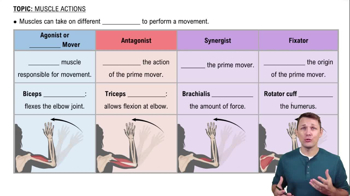
Step 3: Analyze the other muscles listed. The brachialis and brachioradialis mainly contribute to flexion of the elbow, while the biceps brachii also assists in flexion and supination but is primarily a flexor. The triceps brachii is an extensor of the elbow.
Step 4: Determine which muscles rotate the radius without causing flexion or extension. Since pronator teres and supinator perform rotation without significant flexion or extension, they fit the criteria.
Step 5: Conclude that the correct answer is the muscles that perform pure rotation of the radius without flexion or extension, which are the pronator teres and supinator.
Verified video answer for a similar problem:
This video solution was recommended by our tutors as helpful for the problem above
Play a video:
Was this helpful?
Key Concepts
Here are the essential concepts you must grasp in order to answer the question correctly.
Muscle Actions: Rotation vs. Flexion/Extension
Muscle actions describe how muscles move joints. Rotation involves turning a bone around its axis, while flexion and extension refer to bending and straightening a joint. Understanding these distinctions helps identify muscles responsible for specific movements without causing others.
The primary muscles that rotate the radius (forearm bone) are the pronator teres, which pronates (turns palm down), and the supinator, which supinates (turns palm up). These muscles enable rotation without significantly affecting elbow flexion or extension.
Muscles Responsible for Elbow Flexion and Extension
Biceps brachii and brachialis mainly flex the elbow, while triceps brachii extends it. Brachioradialis assists in flexion but also stabilizes the elbow during rotation. Recognizing these roles clarifies which muscles do not contribute to pure rotational movements.