Important flexors of the vertebral column that act in opposition to the erector spinae are the (a) Rectus abdominis (b) Longus capitis (c) Longus colli (d) Scalene
Verified step by step guidance
1
Step 1: Understand the function of the erector spinae muscles. These muscles are primarily responsible for extending the vertebral column, meaning they help you bend backward or maintain an upright posture.
Step 2: Identify what it means to act in opposition to the erector spinae. Muscles that act in opposition to extension are flexors of the vertebral column, meaning they help bend the spine forward.
Step 3: Review the listed muscles and their primary actions: (a) Rectus abdominis is a major flexor of the vertebral column, helping to bend the trunk forward; (b) Longus capitis primarily flexes the head and neck; (c) Longus colli also flexes the neck; (d) Scalene muscles mainly assist in neck flexion and lateral flexion, and also help with breathing.
Step 4: Determine which muscle among the options is the most important flexor of the vertebral column, acting directly opposite to the erector spinae's extension action. The rectus abdominis is the key muscle responsible for flexing the vertebral column.
Step 5: Conclude that the correct answer is the muscle that flexes the vertebral column, which is the rectus abdominis (option a).
Verified video answer for a similar problem:
This video solution was recommended by our tutors as helpful for the problem above
Play a video:
Was this helpful?
Key Concepts
Here are the essential concepts you must grasp in order to answer the question correctly.
Muscles Acting as Flexors of the Vertebral Column
Flexor muscles of the vertebral column are those that decrease the angle between the vertebrae, bending the spine forward. Key flexors include the rectus abdominis, which helps in trunk flexion, and deep neck flexors like longus capitis and longus colli that flex the cervical spine.
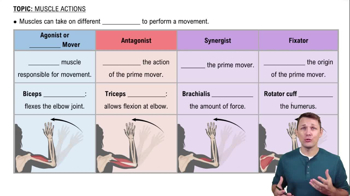
The erector spinae is a group of muscles running along the vertebral column responsible for extending and laterally flexing the spine. They act as antagonists to the flexor muscles by straightening or arching the back, maintaining posture and balance.
Antagonistic muscles work in opposition to each other to control movement. In the vertebral column, flexors like the rectus abdominis oppose extensors like the erector spinae, allowing smooth and controlled spinal movements such as bending forward and returning to an upright position.