Which of the following pairs of base sequences could form a short stretch of a normal double helix of DNA?a. 5′-AGCT-3′ with 5′-TCGA-3′b. 5′-GCGC-3′ with 5′-TATA-3′c. 5′-ATGC-3′ with 5′-GCAT-3′d. All of these pairs are correct.
Verified step by step guidance
1
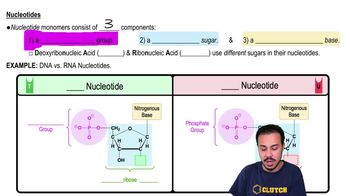
Step 1: Understand that DNA is a double helix structure, where two strands are held together by hydrogen bonds between pairs of nucleotides. The pairs are always adenine (A) with thymine (T), and guanine (G) with cytosine (C).
Step 2: Remember that DNA strands are antiparallel, meaning one strand runs in the 5' to 3' direction, and the other runs in the 3' to 5' direction.
Step 3: Evaluate each option by comparing the base pairs. They should be complementary (A with T, G with C) and the sequences should be in reverse order due to the antiparallel nature of DNA strands.
Step 4: For option a, the sequences are 5′-AGCT-3′ and 5′-TCGA-3′. These are complementary and in reverse order, so they could form a DNA double helix.
Step 5: For option b, the sequences are 5′-GCGC-3′ and 5′-TATA-3′. These are not complementary, so they could not form a DNA double helix.
Step 6: For option c, the sequences are 5′-ATGC-3′ and 5′-GCAT-3′. These are complementary but not in reverse order, so they could not form a DNA double helix.
Step 7: Therefore, only option a could form a short stretch of a normal double helix of DNA.
Was this helpful?
Key Concepts
Here are the essential concepts you must grasp in order to answer the question correctly.
Base Pairing Rules
Base pairing rules dictate how nucleotides in DNA pair with each other. Adenine (A) pairs with Thymine (T), and Cytosine (C) pairs with Guanine (G). This complementary base pairing is essential for the formation of the double helix structure of DNA, ensuring accurate replication and transcription.
DNA is structured as a double helix, consisting of two strands that run in opposite directions (antiparallel). Each strand is composed of a sugar-phosphate backbone and nitrogenous bases. The specific orientation of the strands (5' to 3' directionality) is crucial for understanding how base pairs align and interact within the helix.
Nucleotide sequences refer to the specific order of nucleotides in a DNA strand. The sequence determines the genetic information carried by the DNA. In the context of the question, evaluating whether the given pairs of sequences can form a double helix involves checking for complementary sequences that adhere to the base pairing rules.