Textbook Question
Give a function for each of the following:
(l) Interleukins
(m) Tumor necrosis factor
(n) Colony-stimulating factors
1073
views

 Martini, Nath, Bartholomew 11th EditionCh. 22 The Lymphatic System and ImmunityProblem 14
 Verified step by step guidance
 4:43
4:43
 4:37
4:37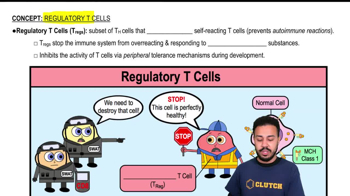 3:53
3:53Give a function for each of the following:
(l) Interleukins
(m) Tumor necrosis factor
(n) Colony-stimulating factors
Blocking the antigen receptors on the surface of lymphocytes would interfere with
(a) Phagocytosis of the antigen
(b) That lymphocyte's ability to produce antibodies
(c) Antigen recognition
(d) The ability of the lymphocyte to present antigen
(e) Opsonization of the antigen
Compared with innate defenses, adaptive defenses
(a) Do not distinguish between one threat and another
(b) Are always present at birth
(c) Protect against threats on an individual basis
(d) Deny the entry of pathogens to the body
What seven defenses, present at birth, provide the body with the defensive capability known as innate (nonspecific) immunity?
Give a function for each of the following:
(a) Cytotoxic T cells
(b) Helper T cells
(c) Regulatory T cells
(d) Plasma cells
(e) NK cells
Give a function for each of the following:
(f) Stromal cells
(g) Epithelial reticular cells
(h) Interferons
(i) Pyrogens
(j) T cells
(k) B cells