A decrease in which population of lymphocytes would impair all aspects of an immune response? (a) Cytotoxic T cells (b) Helper T cells (c) Regulatory T cells (d) B cells (e) Plasma cells
Verified step by step guidance
1
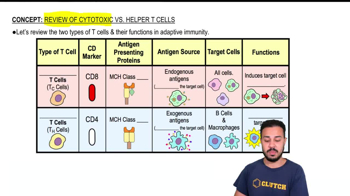
Understand the role of each lymphocyte type in the immune response: Cytotoxic T cells (a) destroy infected or abnormal cells, Helper T cells (b) coordinate the immune response by activating other immune cells, Regulatory T cells (c) suppress immune responses to prevent overactivity, B cells (d) produce antibodies, and Plasma cells (e) are the activated form of B cells that secrete antibodies.
Recognize that the question is asking about a lymphocyte population whose decrease would impair all aspects of the immune response, meaning it plays a central and coordinating role.
Recall that Helper T cells (b) are essential for activating both cytotoxic T cells and B cells, as well as enhancing the activity of other immune cells like macrophages. Without Helper T cells, the immune system's ability to respond to pathogens is severely compromised.
Eliminate the other options: Cytotoxic T cells (a) are important for killing infected cells but do not coordinate the entire immune response. Regulatory T cells (c) suppress immune activity but are not central to initiating it. B cells (d) and Plasma cells (e) are involved in antibody production but rely on Helper T cells for activation.
Conclude that the correct answer is Helper T cells (b), as their decrease would impair all aspects of the immune response due to their central role in immune coordination.
Verified video answer for a similar problem:
This video solution was recommended by our tutors as helpful for the problem above
Play a video:
Was this helpful?
Key Concepts
Here are the essential concepts you must grasp in order to answer the question correctly.
Helper T Cells
Helper T cells, or CD4+ T cells, play a crucial role in the immune response by activating and regulating other immune cells, including B cells and cytotoxic T cells. They are essential for orchestrating the adaptive immune response, and a decrease in their population can lead to a weakened immune system, making it difficult for the body to respond effectively to infections.
Cytotoxic T cells, or CD8+ T cells, are responsible for directly killing infected or cancerous cells. They recognize antigens presented by infected cells and initiate apoptosis. While important for targeting infected cells, their function is heavily reliant on the activation signals provided by helper T cells, indicating that a decrease in helper T cells would also impair cytotoxic T cell activity.
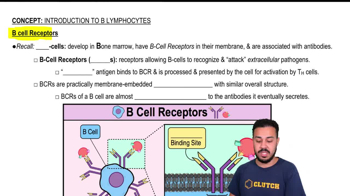
B cells are a type of lymphocyte that produce antibodies in response to antigens. They are crucial for humoral immunity, which is the aspect of the immune response that involves the production of antibodies to neutralize pathogens. Helper T cells are vital for B cell activation and differentiation, meaning that a decrease in helper T cells would significantly impair B cell function and the overall immune response.