
Textbook Question
The chewing muscles that protract the mandible and produce side-to-side grinding movements are the
a. Buccinators
b. Masseters
c. Temporalis
d. Pterygoids
1417
views

 Verified step by step guidance
 7:16
7:16
 4:43
4:43 5:41
5:41The chewing muscles that protract the mandible and produce side-to-side grinding movements are the
a. Buccinators
b. Masseters
c. Temporalis
d. Pterygoids
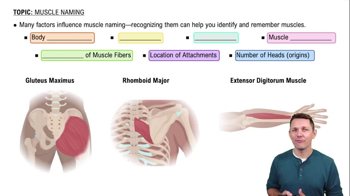
Which criterion (or criteria) is/are used in naming the gluteus medius?
a. Relative size
b. Muscle location
c. Muscle shape
d. Action
e. Number of origins
Muscles that depress the hyoid bone and larynx include all but the:
a. Sternohyoid
b. Omohyoid
c. Geniohyoid
d. Sternothyroid
Intrinsic muscles of the back that promote extension of the spine (or head) include all but:
a. Splenius muscles
b. Semispinalis muscles
c. Scalene muscles
d. Erector spinae
The prime mover of thigh extension against resistance is the:
a. Gluteus maximus
b. Gluteus medius
c. Biceps femoris
d. Semimembranosus
A prime mover of thigh flexion is the:
a. Rectus femoris
b. Iliopsoas
c. Vastus muscles
d. Gluteus maximus