Identify at least two events in the cell cycle that must be completed successfully for daughter cells to share an identical complement of chromosomes.
Verified step by step guidance
1
Understand that the cell cycle consists of several phases, including interphase (G1, S, G2) and mitotic phase (mitosis and cytokinesis).
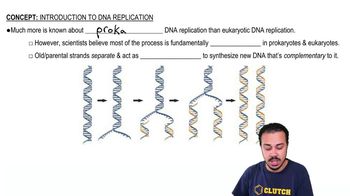
Recognize that during the S phase of interphase, DNA replication occurs, ensuring that each chromosome is duplicated to form two sister chromatids.
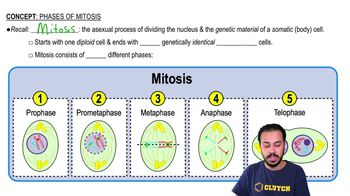
Identify that during mitosis, specifically in the metaphase, chromosomes align at the metaphase plate, ensuring that each daughter cell will receive one copy of each chromosome.
Acknowledge that during anaphase, the sister chromatids are pulled apart to opposite poles of the cell, ensuring that each daughter cell receives an identical set of chromosomes.
Conclude that successful completion of DNA replication in the S phase and proper segregation of chromosomes during mitosis are crucial for daughter cells to have identical chromosome complements.
Verified video answer for a similar problem:
This video solution was recommended by our tutors as helpful for the problem above.
Video duration:
1m
Play a video:
0 Comments
Key Concepts
Here are the essential concepts you must grasp in order to answer the question correctly.
DNA Replication
DNA replication is the process by which a cell duplicates its DNA before cell division. This ensures that each daughter cell receives an exact copy of the genetic material. The replication occurs during the S phase of the cell cycle, where the double helix unwinds and each strand serves as a template for creating a new complementary strand.
Mitosis is the phase of the cell cycle where the replicated chromosomes are separated into two new nuclei. This process includes several stages: prophase, metaphase, anaphase, and telophase. Successful completion of mitosis ensures that each daughter cell receives an identical set of chromosomes, maintaining genetic consistency across cell generations.
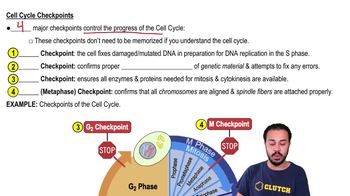
Checkpoint mechanisms are regulatory pathways in the cell cycle that ensure each phase is completed accurately before the cell proceeds to the next stage. Key checkpoints, such as the G1, G2, and M checkpoints, monitor DNA integrity, replication success, and proper chromosome alignment. These checkpoints are crucial for preventing errors that could lead to unequal distribution of chromosomes in daughter cells.

 1:52 minutes
 Verified step by step guidance
 03:37
03:37