Enzymes speed up chemical reactions by .
a. heating cells;
b. binding to substrates and placing stress on their bonds;
c. changing the shape of the cell;
d. supplying energy to the substrate
Verified step by step guidance
1
Identify the role of enzymes in chemical reactions. Enzymes act as biological catalysts.
Understand that enzymes work by binding to substrates. The image shows an enzyme (A) with substrates (B) bound to its active site.
Recognize that enzymes place stress on the bonds of the substrates. This stress helps to lower the activation energy required for the reaction.
Analyze the options provided: heating cells, binding to substrates and placing stress on their bonds, changing the shape of the cell, and supplying energy to the substrate.
Conclude that the correct answer is the option that describes the enzyme's function of binding to substrates and placing stress on their bonds.
Verified video answer for a similar problem:
This video solution was recommended by our tutors as helpful for the problem above.
Video duration:
2m
Play a video:
0 Comments
Key Concepts
Here are the essential concepts you must grasp in order to answer the question correctly.
Enzyme-Substrate Interaction
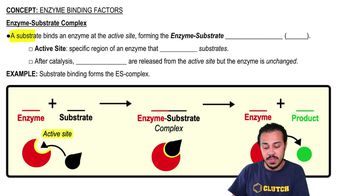
Enzymes are biological catalysts that speed up chemical reactions by binding to specific substrates. This interaction occurs at the enzyme's active site, where the substrate fits like a key in a lock. The binding induces a change in the enzyme's shape, facilitating the conversion of substrates into products.
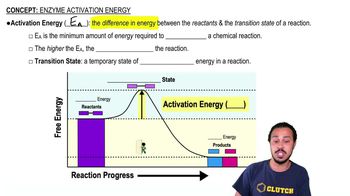
Activation energy is the minimum energy required for a chemical reaction to occur. Enzymes lower this energy barrier, allowing reactions to proceed more quickly and efficiently. By stabilizing the transition state, enzymes make it easier for substrates to react, thus speeding up the overall reaction rate.
The induced fit model describes how enzymes change shape upon substrate binding. Unlike the lock-and-key model, which suggests a perfect fit, the induced fit model emphasizes that the enzyme's active site molds itself around the substrate. This dynamic interaction enhances the enzyme's ability to catalyze reactions by stressing certain bonds within the substrate.

 2:39 minutes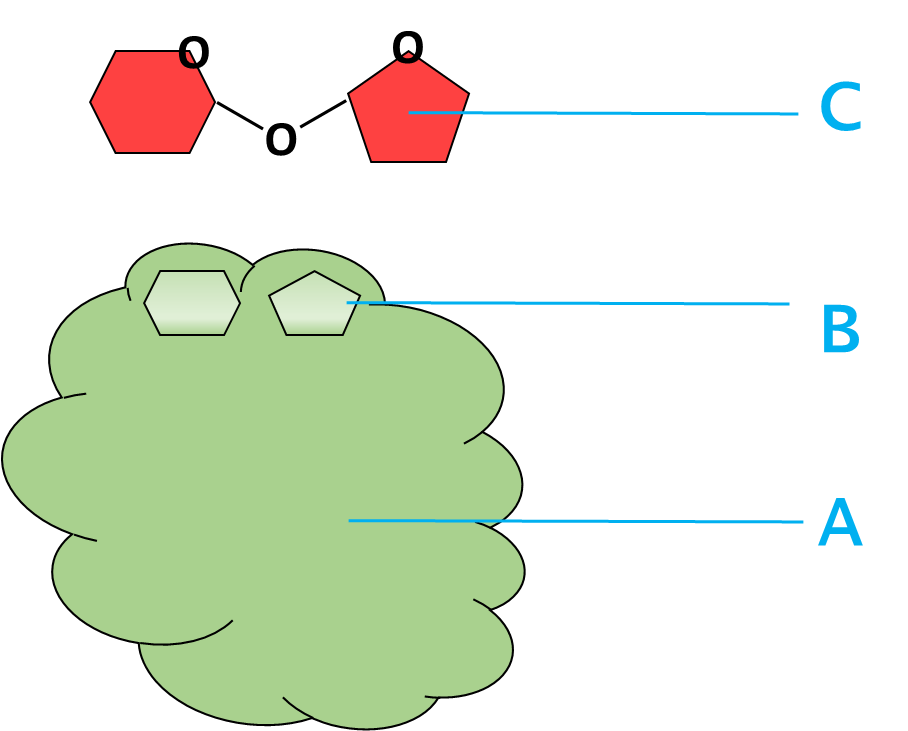
 Verified step by step guidance
 03:49
03:49