Biologists think that endosymbiosis gave rise to mitochondria before plastids partly because
a. the products of photosynthesis could not be metabolized without mitochondrial enzymes.
b. all eukaryotes have mitochondria (or their remnants), whereas many eukaryotes do not have plastids.
c. mitochondrial DNA is less similar to prokaryotic DNA than is plastid DNA.
d. without mitochondrial CO2 production, photosynthesis could not occur.
Verified step by step guidance
1
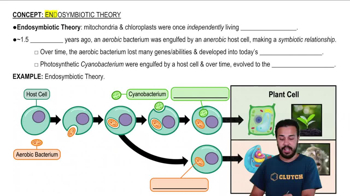
Identify the key concept: Endosymbiosis is a theory that explains the origin of mitochondria and plastids in eukaryotic cells.
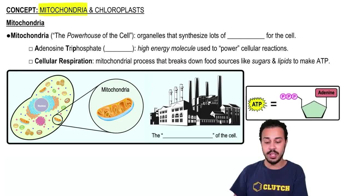
Understand the role of mitochondria and plastids: Mitochondria are involved in energy production through cellular respiration, while plastids, such as chloroplasts, are involved in photosynthesis.
Analyze the options: Consider the evidence supporting the sequence of endosymbiotic events leading to mitochondria and plastids.
Evaluate option b: Recognize that all eukaryotic cells have mitochondria or their remnants, suggesting mitochondria appeared before plastids, which are not present in all eukaryotes.
Conclude based on evidence: The presence of mitochondria in all eukaryotes supports the idea that mitochondria arose before plastids in the evolutionary timeline.
Verified video answer for a similar problem:
This video solution was recommended by our tutors as helpful for the problem above.
Video duration:
55s
Play a video:
0 Comments
Key Concepts
Here are the essential concepts you must grasp in order to answer the question correctly.
Endosymbiotic Theory
The endosymbiotic theory posits that certain organelles, specifically mitochondria and plastids, originated from free-living prokaryotes that were engulfed by ancestral eukaryotic cells. This theory explains how these organelles have their own DNA and replicate independently, supporting the idea that they were once separate organisms that formed a symbiotic relationship with host cells.
Mitochondria are organelles responsible for energy production through cellular respiration, while plastids, such as chloroplasts, are involved in photosynthesis. The presence of mitochondria in all eukaryotes suggests a fundamental role in energy metabolism, whereas plastids are only found in specific groups, indicating a later evolutionary development linked to photosynthesis.
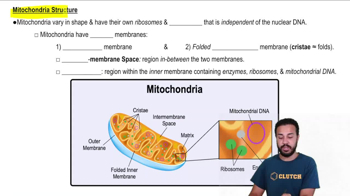
Mitochondrial DNA (mtDNA) is distinct from nuclear DNA and is inherited maternally. It is more similar to prokaryotic DNA than to nuclear DNA, supporting the idea that mitochondria originated from prokaryotic ancestors. This genetic evidence is crucial for understanding the evolutionary history of eukaryotic cells and their organelles.

 0:55 minutes
 Verified step by step guidance
 07:29
07:29