
Ch. 3 The Cellular Level of Organization
Martini - Fundamentals of Anatomy & Physiology 11th Edition
Martini, Nath, Bartholomew11th EditionFundamentals of Anatomy & PhysiologyISBN: 9780136874089Not the one you use?Change textbook
Chapter 3, Problem 29

A molecule that blocks the ion channels lining integral proteins in the plasma membrane would interfere with
(a) Cell recognition
(b) The movement of lipid-soluble molecules
(c) Producing changes in the electrical charges across a plasma membrane
(d) The ability of protein hormones to stimulate the cell
(e) The cell's ability to divide

Verified step by step guidance
1
Step 1: Understand the role of ion channels in the plasma membrane. Ion channels are integral membrane proteins that allow specific ions to pass through the membrane, contributing to the movement of charged particles across the membrane.
Step 2: Recognize that blocking ion channels would prevent ions from moving across the membrane, which directly affects the electrical charge distribution on either side of the membrane.
Step 3: Recall that changes in electrical charges across the plasma membrane are essential for processes like generating action potentials and maintaining membrane potential.
Step 4: Evaluate each option in the problem: (a) Cell recognition involves surface markers, not ion channels; (b) Movement of lipid-soluble molecules occurs through the lipid bilayer, not ion channels; (c) Changes in electrical charges depend on ion movement through channels; (d) Protein hormones stimulate cells via receptors, not ion channels; (e) Cell division is a complex process not directly dependent on ion channels.
Step 5: Conclude that blocking ion channels would most directly interfere with producing changes in electrical charges across the plasma membrane, corresponding to option (c).

Verified video answer for a similar problem:

This video solution was recommended by our tutors as helpful for the problem above.
Video duration:
3m
Was this helpful?

Key Concepts

Here are the essential concepts you must grasp in order to answer the question correctly.

Ion Channels in Plasma Membrane

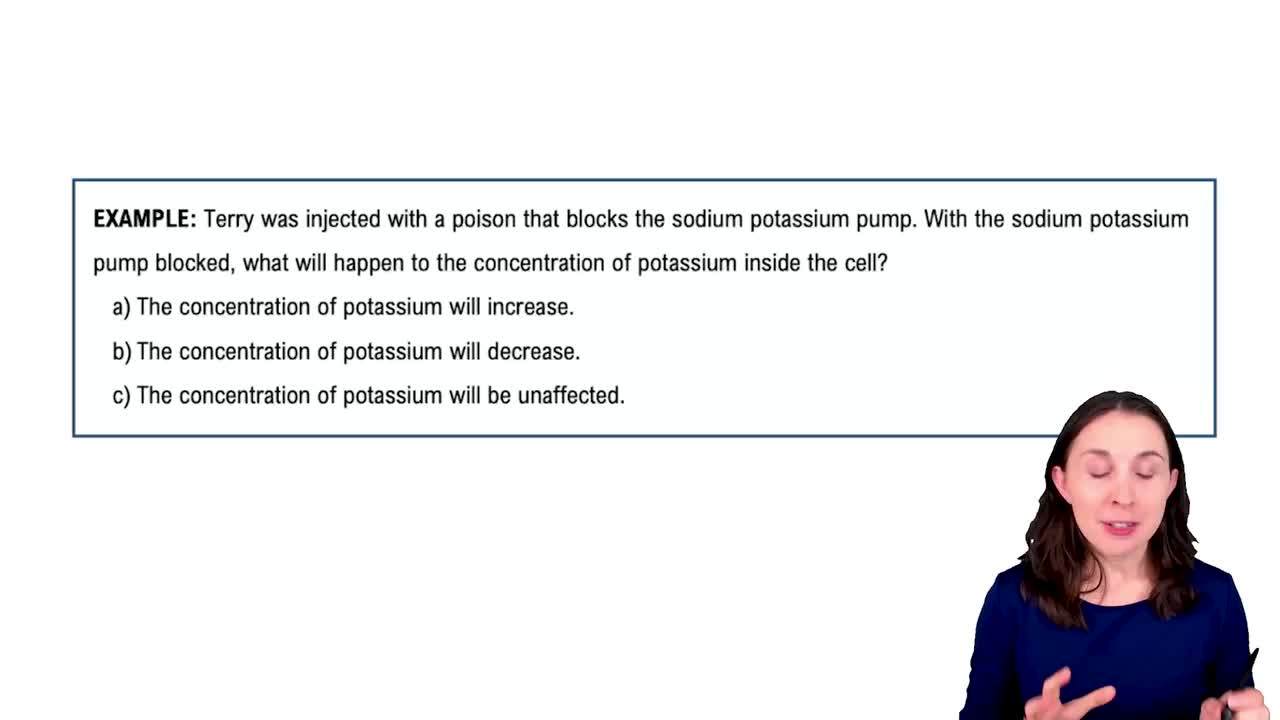
Ion channels are integral membrane proteins that allow specific ions to pass through the plasma membrane, facilitating ion flow and maintaining cellular homeostasis. Blocking these channels disrupts ion movement, affecting processes like electrical signaling and membrane potential.
Recommended video:
01:55
Ions - Sodium and Potassium Example 3

Membrane Potential and Electrical Charges

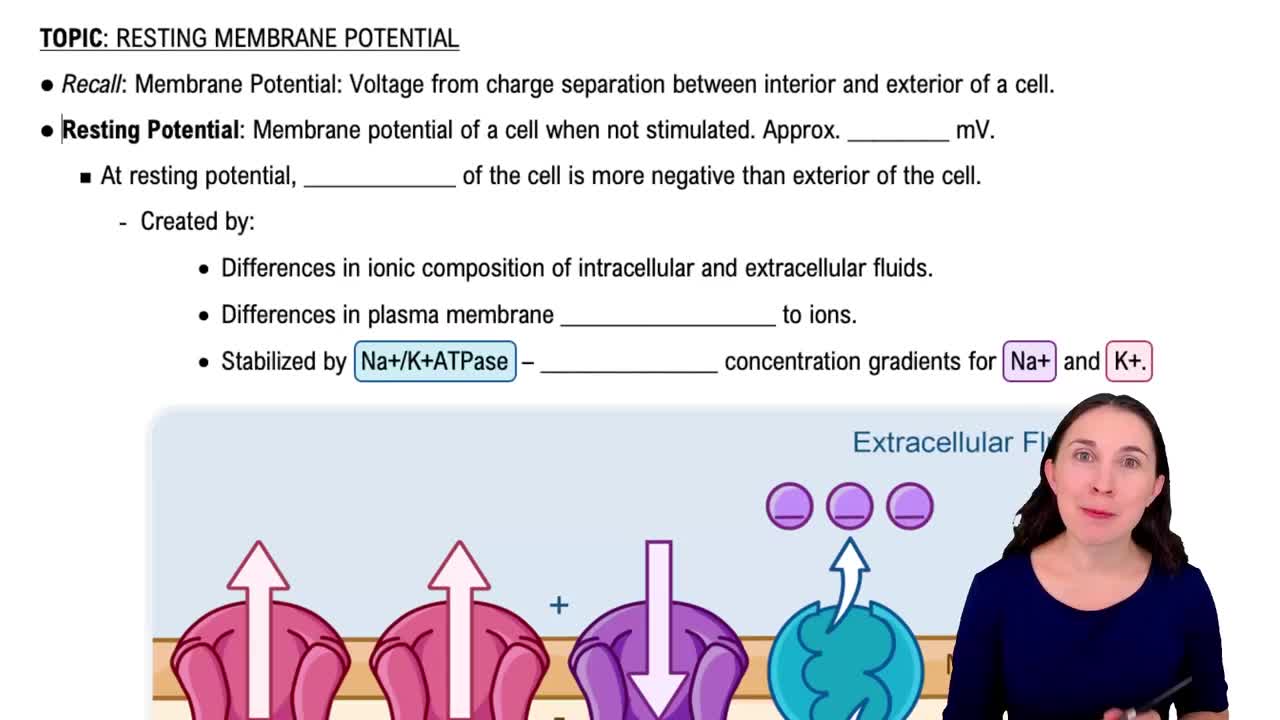
The plasma membrane maintains a voltage difference (membrane potential) due to ion distribution across it. Changes in ion flow through channels alter this electrical charge, which is crucial for functions such as nerve impulse transmission and muscle contraction.
Recommended video:
07:53
Resting Membrane Potential

Cell Recognition and Signaling

Cell recognition involves membrane proteins that identify and interact with other cells or molecules, often through glycoproteins. While ion channels are not primarily responsible for recognition, blocking them does not directly affect cell recognition or hormone signaling.
Recommended video:
4:24
Pattern Recognition Receptors