Matter occupies space and has mass. Explain how energy must be described in terms of these two factors. Then define energy.
Verified step by step guidance
1
Step 1: Begin by explaining the concept of matter. Matter is anything that occupies space and has mass, meaning it has physical substance and can be measured in terms of volume and weight.
Step 2: Clarify that energy, unlike matter, does not occupy space and does not have mass. Energy is not a physical substance but rather a property or capacity that enables matter to perform work or undergo change.
Step 3: Describe how energy interacts with matter. Energy can be transferred to matter, causing changes in its state, motion, or structure. For example, thermal energy can increase the temperature of matter, and mechanical energy can move objects.
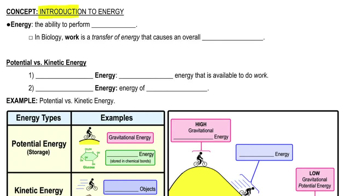
Step 4: Define energy. Energy is the capacity to do work or produce change. It exists in various forms, such as kinetic energy (energy of motion), potential energy (stored energy), chemical energy (energy stored in chemical bonds), and thermal energy (heat).
Step 5: Conclude by emphasizing the distinction between matter and energy. While matter occupies space and has mass, energy is a measurable property that influences matter but does not itself occupy space or have mass.
Verified video answer for a similar problem:
This video solution was recommended by our tutors as helpful for the problem above
Video duration:
1m
Play a video:
Was this helpful?
Key Concepts
Here are the essential concepts you must grasp in order to answer the question correctly.
Mass
Mass is a fundamental property of matter that quantifies the amount of substance in an object. It is typically measured in kilograms or grams and is a measure of an object's resistance to acceleration when a force is applied. In the context of energy, mass is crucial because it relates to the energy content of matter, as described by Einstein's equation E=mc², which shows that mass can be converted into energy.
Space occupation refers to the physical volume that matter occupies in three-dimensional space. This concept is essential for understanding energy because energy can influence the arrangement and movement of matter within that space. For example, when energy is added to a substance, it can change its state (solid, liquid, gas) and thus alter how it occupies space.
Energy is defined as the capacity to do work or produce change. It exists in various forms, including kinetic, potential, thermal, and chemical energy, and can be transformed from one form to another. Understanding energy in relation to mass and space is vital, as it helps explain how energy interacts with matter, influencing its motion, structure, and state.