Gas exchange at the blood air barrier is efficient because (a) The differences in partial pressure are substantial (b) The gases are lipid soluble (c) The total surface area is large (d) Of all of these
Verified step by step guidance
1
Step 1: Understand the process of gas exchange at the blood-air barrier, which occurs in the alveoli of the lungs where oxygen and carbon dioxide diffuse between the air in the alveoli and the blood in the pulmonary capillaries.
Step 2: Recognize that efficient gas exchange depends on several factors, including the difference in partial pressures of gases, the solubility of gases in the membrane, and the surface area available for diffusion.
Step 3: Analyze each option: (a) A substantial difference in partial pressure drives diffusion of gases according to Fick's law, increasing efficiency; (b) Gases like oxygen and carbon dioxide are lipid soluble, allowing them to pass through the alveolar and capillary membranes easily; (c) A large total surface area of the alveoli provides more space for gas exchange to occur.
Step 4: Combine these factors to understand that all contribute to the efficiency of gas exchange, making option (d) 'Of all of these' the most comprehensive answer.
Step 5: Conclude that the efficiency of gas exchange at the blood-air barrier is due to the combined effects of substantial partial pressure differences, gas solubility, and large surface area.
Verified video answer for a similar problem:
This video solution was recommended by our tutors as helpful for the problem above
Play a video:
Was this helpful?
Key Concepts
Here are the essential concepts you must grasp in order to answer the question correctly.
Partial Pressure Gradient
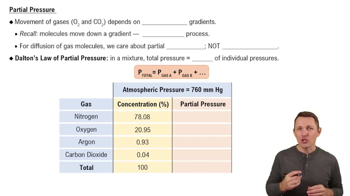
Gas exchange relies on differences in partial pressures of oxygen and carbon dioxide between alveolar air and blood. A substantial gradient drives diffusion, allowing oxygen to enter the blood and carbon dioxide to leave efficiently.
Oxygen and carbon dioxide are lipid-soluble gases, enabling them to easily diffuse across the thin lipid bilayer of alveolar and capillary membranes, facilitating rapid gas exchange.
The large total surface area of alveoli provides an extensive interface for gas exchange, increasing the amount of oxygen and carbon dioxide that can diffuse simultaneously, enhancing overall efficiency.