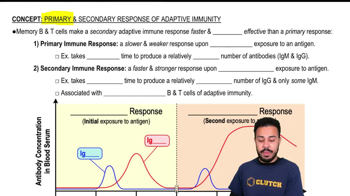
Mark the following statements as true or false. If a statement is false, correct is to make a true statement. In the primary immune response, the lag phase lasts about 5 days, during which time B cells proliferate and differentiate.
Verified step by step guidance
1
Step 1: Understand the primary immune response. The primary immune response occurs when the immune system encounters an antigen for the first time. During this response, B cells are activated, proliferate, and differentiate into plasma cells and memory B cells.
Step 2: Analyze the lag phase of the primary immune response. The lag phase refers to the period between the initial exposure to the antigen and the production of detectable levels of antibodies. This phase typically lasts about 3-6 days, not exactly 5 days.
Step 3: Evaluate the statement provided. The statement claims that the lag phase lasts about 5 days and involves B cell proliferation and differentiation. While the latter part of the statement is true, the duration of the lag phase is not fixed at 5 days; it varies between 3-6 days.
Step 4: Correct the false part of the statement. The corrected statement should read: 'In the primary immune response, the lag phase lasts about 3-6 days, during which time B cells proliferate and differentiate.'
Step 5: Confirm the corrected statement aligns with the scientific understanding of the primary immune response and its lag phase duration.
Verified video answer for a similar problem:
This video solution was recommended by our tutors as helpful for the problem above
Play a video:
Was this helpful?
Key Concepts
Here are the essential concepts you must grasp in order to answer the question correctly.
Primary Immune Response
The primary immune response is the initial reaction of the immune system to a specific pathogen. It typically involves a lag phase, during which the body recognizes the pathogen and begins to activate B cells and T cells. This response can take several days to develop fully, as the immune system must produce specific antibodies and memory cells to effectively combat the pathogen.
Primary and Secondary Response of Adaptive Immunity
Lag Phase
The lag phase is the period in the primary immune response where no detectable antibodies are present in the serum. This phase usually lasts about 5 to 10 days, during which B cells undergo clonal expansion and differentiation into plasma cells that produce antibodies. Understanding this phase is crucial for grasping how the immune system prepares to fight off infections.
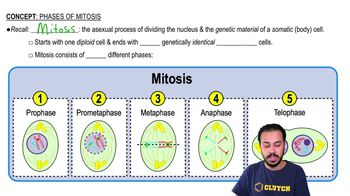
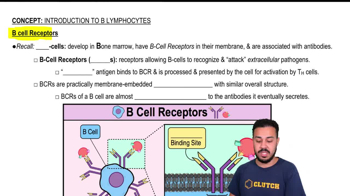
B cell proliferation refers to the rapid division of B cells after they encounter an antigen. Differentiation is the process by which these activated B cells develop into plasma cells that secrete antibodies or memory B cells that provide long-term immunity. This process is essential for establishing an effective immune response and ensuring that the body can respond more rapidly to future infections by the same pathogen.